
Desert Tree
Desert Tree
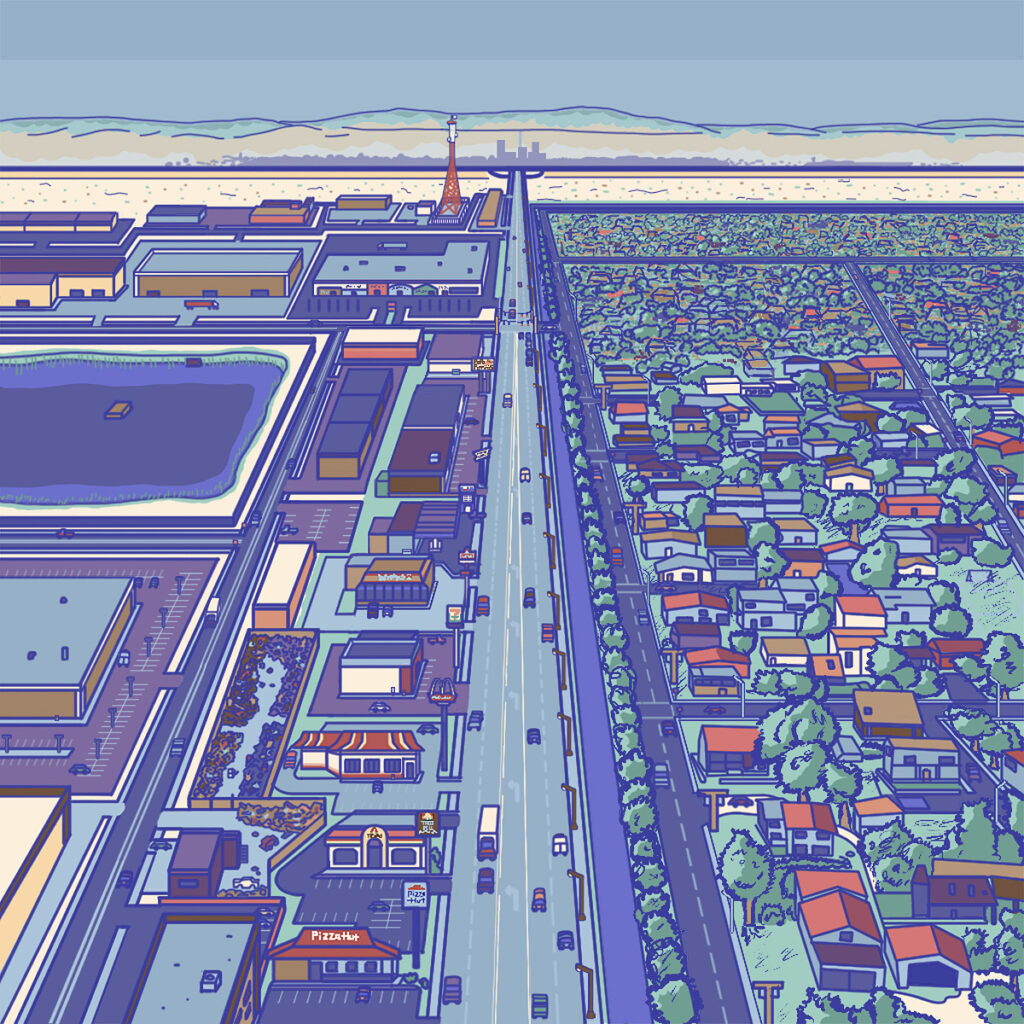
First opened for residents in 1960 and initially expanded upon through the following decade, Desert Tree (seen in the above archival photograph along Kettle Road on an early morning in 1999) was the city’s final big project led by founder Hadron McMare, starting during his own eight-year mayoral term, while he was dealing with the controversy of his repeated casino visits and rumored associations with criminal organizations. Despite some delays and budget overruns, the first two hundred homes were put up for sale and moved into in the summer of 1960, just prior to the inaugural school year at Sherman Miller Elementary, named after the civil engineer and designer of the neighborhood.
Said to have missed the greenery of his native Scotland by some, or simply envious of midwestern-style suburbs by others, McMare made a point of bringing a lush (by desert valley standards) single family home environment to the rapidly growing Royal Valley, which he accomplished after some challenges. The sprawling suburb’s sycamore trees and green lawns were made possible by both a small natural spring in the area, and by filling the bordering canals through the diversion of some of the water from the San Baro river, many miles away and at the edge of city limits.
Like the city itself, Desert Tree grew faster than expected, and saw two major further expansions. As thousands flocked to the suburb, another school was determined to be needed to serve the young population, and Desert Tree Elementary joined the other three schools (including Cookton Middle and Steader High) in 1976. There was only location that made sense for it, and its construction permanently ended McMare’s long-stalled attempt to build a golf course closer to the center of the neighborhood. Despite losing his “cherry on top” project, McMare retained that the district was his proudest accomplishment.
Built where there was once only farms and desert, today Desert Tree is in the top ten of suburban neighborhoods sought out by families or those expecting to start one in California. Just across the interstate from Royal Valley, it remains close to all the big city amenities yet maintains its own identity. For those who don’t want to travel into the city, there’s also the main and old highway of Kettle Road, where strip malls, fast food, and casual-fast dining places have sprouted up over the years, along with several department stores. At the terminating side of Kettle is Royal Valley’s second-smallest district, historic Kettlebrook, which is said to start at the famous but empty McMare Manor. The Valley Mall, nestled in the heart of the commercial and warehouses area opposite Desert Tree, also owes its existence to McMare’s realized vision.
Desert Tree has become a safe and friendly place for children, whose happiness remains above the national average. Kids are often seen playing and exploring the neighborhood, and ‘local lore’ and urban legends about the district have built up and been update over the generations. The schools are within biking distance for many of them, as well, reducing automotive traffic. And while Desert Tree lacks services and venues itself, nearly everything one would need on a daily basis can be found just across the street, which can be accessed via several different exits.
Most of the homes remain original, built from the 1950s through the 1970s, and the only segment of the neighborhood that has ever been lost was Mansion Street, known for its lovely cottages and unfortunately demolished to open up a much-needed new main entrance. Even so, these homes remain immortalized in our gallery. For those seeking blocks with personality instead of the mass-manufactured “factory” homes that are common today, Desert Tree is the place to be or raise a family. Let your kids leave their mark here next! We believe we’re still just getting started.
~ From the Desert Tree History and Community Website