
Backwards Backfire
ta – Backwards Backfire
Use the arrows or swipe/drag mouse to navigate pages.
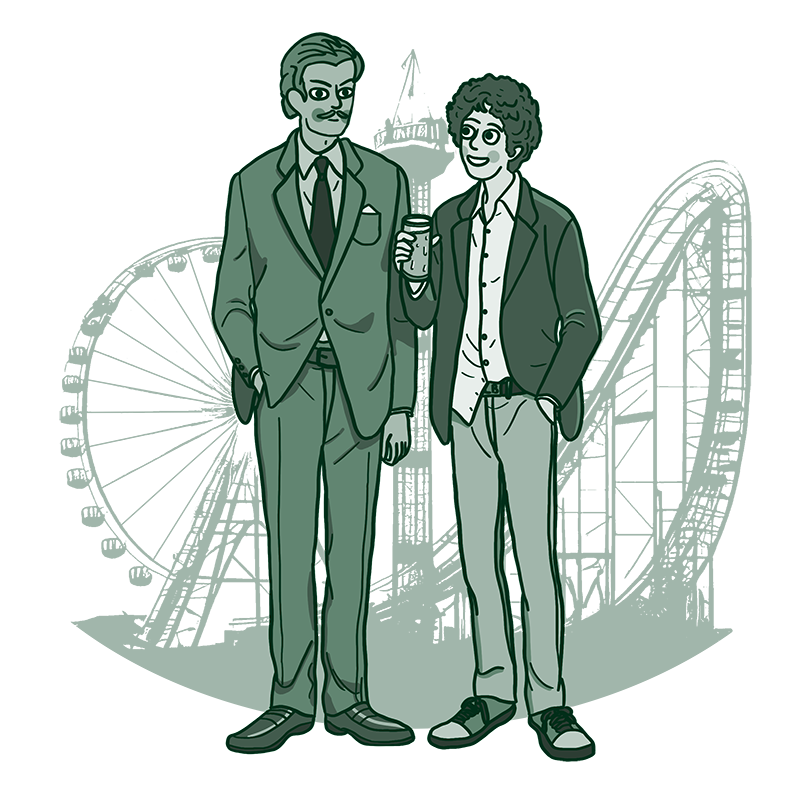
1975
Backwards Backfire
Anomaly: Parts or the entirety of this event are no longer canonical
Something had gone very, very wrong with the experiment. But for the first few seconds following the disaster, André had been left so overwhelmed and bewildered, that this obvious and simple fact didn’t occur to him right away. The smell of ozone was pervasive in the air, as was smoke. Small fires on the system control array were going out on their own, but the sparks that kept popping up threatened to create more—until the capacitors throughout the time chamber’s external machinery gave out, and everything in the lab shut down for good, including the various alarms. The dim emergency lights activated, and the only remaining sound came from the wailing smoke detectors.
“Wes…?” André said after several coughs as he stood himself up, and tried to keep steady against the chair he’d been sitting on during the test. “Wes, do you…” He looked through the glass, at the chamber where his life’s work once existed: a big sphere that was designed to allow one to look back at the past and have it projected all around them. Now, however, it was completely gone, replaced by a cavity of smooth rock. Even without lights, he could see that it simply was not there. “Oh, God… What happened?”
He tried what few physical buttons and dials were on the mostly-touchscreen display of the desk loaded with 2040s tech, realized there was nothing to be done, and then reached into one of the drawers and took out a compact but powerful flashlight.
“Why’s the power out…?” he asked himself and carefully left the control room, watching for loose wires and debris. “The generator should have kicked on.”
He navigated the darkened metal hallways of his Time Lab, which he’d planned to open to private investors by 2047 or so, depending on the success of the tests. But now his business and creative partner was nowhere to be found. Was he even… alive?
“Wes… where did you go? How did it go so wrong?” he murmured, just so that he could hear something other than the constant smoke alarms.
The backup generator room, where a small hydrogen power plant took up the bulk of the space, was also filled with dissipating smoke. Perhaps it had been overloaded somehow, or there had been a major fault or short. Over the next few minutes, André checked all the wiring, taking off his jacket as he did so; without air filtration, the temperature in the lab underneath the King Arcade ruins was getting hot, fast.
“Here goes…” he grumbled and hit the breaker to get the generator back online, hoping that nothing would explode within the complex. “Ah. Good. There’s hope.”
The air vent fans helped to clear the smoke, and the alarms died down by the time André made it back to the control room. The chronosphere’s lights had gone with the rest of it, leaving an eerie abyss past the window. Nothing seemed to remain of Wes.
The generator wouldn’t last for too long, so André made use of his time by trying to find out what had happened via the touchscreen console. But every next tap on the display brought only more disappointment. Whatever went wrong, it was something so unexpected and exotic, that the system simply had no way to effectively describe it past a cascade of “unknown anomaly” markers that were recorded several hundred times within a few seconds. Frustrated, he hit the display with a fist and sunk into his arms.
“Damn it, damn it, damn it…” he groaned, and took a deep breath. He was able to calm down, and then thought about the possibilities. “No explosion… All outside power disconnected… Could we have…?” A distinct but seemingly unlikely possibility occurred to him, and with nervous fingers, he accessed the system’s chronometer; an advanced clock that could detect the current date with its own measurements. After a few seconds of calculations, it spat out a result, and André’s eyes grew wide. “That’s… impossible…”
For a little while, André stayed in his chair and weighed all his options. There weren’t many. Practically none, in fact. Somehow, inexplicably, he and the entire lab had gone into the past, while Wes was possibly sent elsewhere. Maybe the future? Whatever it was that had occurred, Mr. Corathine now found himself in a time before his birth. He didn’t exist yet; he was no one. He could only be glad that he hadn’t gone back further.
Buckling down and beginning to accept his bizarre circumstances, he went to his small bedroom in the lab, opened his wall safe, took out the emergency gold inside of it he once considered a “rainy day” fund, and changed into fresh business attire that was not covered in soot. The suit was from seventy years in the future and didn’t fit into the era, but he’d deal with it soon enough; that was already on the top of a long agenda, as one of the first steps in a complicated plan he was still formulating in his genius head.
“Sorry, Wes. Sorry, Time Lab,” he said as he set the generator timer to shut it off in five minutes. “I don’t know what happened. But I’ll work to fix all this, I swear.”
After starting the countdown, he returned to the elevator, which he could only hope still existed. Nervously, he pressed the call button and waited. When the lift did arrive, he found that it was the same one as before. But cleaner, and in better condition.
Whatever had happened to the lab, the temporal effects seemed to have ended a few feet before the elevator shaft and left the original, older version of it intact. Yet it was also powered once again, this time by technology that was decades away from being invented. It felt like a big, lucky break that the conduits under the floor were able to stay connected, even after they sharply transitioned to the updated wiring of the Time Lab.
In 2045, the elevator’s top stop opened up on what was left of the Galaxy Hub arcade building. Now, however, it led to the last standing but hollowed-out structure of Royal Valley’s airbase, which closed in 1960 and had faced a long demolition process. With a ding, the doors opened before a concrete room that was still being used by the crews as a rest area of sorts. A foldout table and an old lightbulb were all that remained inside, along with some empty soda cans with antiquated labels that André had only seen in pre-80s movies. With a briefcase full of gold and other essentials in hand, he stepped through the thick rubber strip door that had been set up to separate the room from the elements, exiting the biggest of the airbase’s last remnants. Amid what rubble remained in a nearly entirely flattened sprawling vacant field with little plant life, he took in the sight of where King Arcade would one day be, and the sunset skyline of the city.
“It’s… a smaller space than I would’ve imagined, Wes,” he commented like his missing friend was near him. “Then again, you always did appreciate how designers of amusement parks could do a lot to make them look bigger.” He turned back towards the office buildings. As he started walking to the gate, he remarked, “City looks like it has a buzz cut. All that stands out are the Torus and Dawn Tower. She must be brand new.” He then added with a sigh, “And I think I have to find a way to get into one of them…”
André slipped past the chain-link gate, fortunately left unlocked despite a posted no trespassing sign, and gazed out at the well-established Captain Salty restaurant across the filled reservoir in the area. Hungry after the efforts he went through down below, his stomach growled, but he resisted the temptation. Money was going to be tight for a while, so only cheap meals would do for the immediate future.
After crossing the nearest busy street, he noticed a couple things he hadn’t seen since he was a child: a payphone, and the newspaper dispensary beside it. He crouched down to see the sample and further confirm his arrival date. Headlining this issue of the Herald: a successful docking of American and Russian spacecraft. It was July 18th, 1975.
Shortly before the downtown jewelry store closed, André emerged under a sky of twilight, and always a gentleman, turned to wave at the proprietor who had lightened his briefcase. He then looked at the five hundred dollars in his hands and said aloud as he stuck them in his wallet, “It’s not much, Wes, but it may be enough to get me situated.”
He took another deep breath and looked down both directions of Main Street to soak in the view of the area on a Friday night, in a transitionary era. “Hm. Still looks so much like it did in all those archival 1950s black and white photos. But, not for much longer. The old things are on their way out.” He gazed up at the sky wistfully. “What did you think of Royal Valley’s classic age, Grandpa? Was it truly better, just because it was all in the past? Well… I’m here now. I guess I can get a taste of what little is left.”
Thinking about food again, he headed towards The Queen theater—and was keenly aware on the way that his odd attire was garnering some stares from the others that were enjoying the evening in their typical, appropriately unattractive 1970s wear. André was not an appreciator of the decade’s fashion—the high-end stuff was okay—but he knew he’d have to do something about that soon and join the crowd. Unfortunately.
When he arrived at what used to be Royal Valley’s premiere movie theater, he of course had to give the marquee a glance. Jaws was the big one, naturally. The line leading to the box office kiosk was probably mostly just for its next showing. Monty Python and the Holy Grail was still playing, as well, which elicited a smirk from André.
“Ah, yes. I may need to see that while I’m here.”
He walked past the entrance and the line, and then recalled something about the year. To test his local history knowledge, he turned around and looked at the other side of the marquee, and saw that two more movies were listed: The Return of the Pink Panther, and Rollerball. Alongside the latter lingered the announcement, “Now with 4 Screens!”
“Thought so…” André said to himself playfully smugly. “Tsk. Shame, though. I just missed the original pair of larger, more elegant theaters. But it’s understandable.” He glanced at the long line of patrons. “This is the birth year of the summer blockbuster.”
“Hey, mister!” a teenage boy in a jean jacket called out to him, as he held his giggling date at his side. “Where’d you get those killer threads? That a new brand?”
“Tailor-made, I’m afraid,” André replied with a smile. “Try not to jump if she holds onto you extra tight during the shark attack scenes. Those are nails, not teeth.”
The young lady got a kick out of that, and André bid them adieu before crossing the street. Another dining staple in Royal Valley, and a cheaper one, was Midge’s. The authentic 1950s-style diner with is flickering neon lights, dirtied checkerboard floor, and pinball machines had seen better days, but the classic eatery did have a couple years left.
“Welcome in, honey,” an older waitress who could’ve easily been working at the joint since it opened said after the bell above the door sounded. “Sit anywhere ya like.”
With the jukebox playing hits from the 50s off in the corner, André opted for a stool at the counter instead of one of the many empty plushy booth tables. Once he was a handed a menu, he had to stifle a chuckle upon seeing the low 1975 prices.
Too hungry to browse, he told the waitress on her first pass, “Cheeseburger and fries, with a coffee…” He felt the stack of various bills forming a lump in his pocket before adding, “Actually, a chocolate shake, too. Extra whipped cream. Please.”
“Sure thing, sweetie,” she said, scribbled it down, and put it up for the kitchen.
After a little bit, one of the few other customers in the restaurant grumbled from a couple stools away as he hunched over his coffee, “Never should’a come back to this city… All those years servin’, and it didn’t count for squat. Always erasing history…”
“Uh, sir? Excuse me—are you all right?” André asked, a little concerned.
The man swiveled towards him and muttered without looking up, “I returned to the town where I grew up, hoping to get a job flying planes out of the airport. Been traveling the world for a while now. Didn’t even know they tore down the airbase. How am I supposed to get my records to the airline now? Was looking to settle down here, but I have no idea who to talk to or who’s holding proof of my hours.”
“Oh. Wow, you flew sorties over the valley, huh? Aren’t any of your old wingmen still around? I’m sure at least one of them must know who to contact.”
“Yeah, maybe… I just came home without much left to my name. Thought I was special, and blew through my parents’ inheritance seeing other countries. I got nothing.”
Barely needing to think it over, André reached into his wallet, pulled out a fifty, and tried to hand it to the former airman, who was shocked by the sudden generosity.
“N-no, I couldn’t possibly. It’s too much. I don’t even know you, sir.”
“Take it,” André insisted as a juicy burger arrived. He took a sip of his shake and added, “The best time to help people, is when they’re trying to begin again.”
The next stage of the plans began the next morning with an alarm going off on a hotel’s woodgrain clock radio. Needing to make the most of every day, André got going earlier than he had in many years, even while working on the Time Lab. He got cleaned up, dressed, and then went to his room’s wall safe to take out his dwindling sum of cash.
From the second-floor window of the old Royal Valley Inn, he looked out at dawn’s light over the long stretch of Kettle Road, puffed his cheeks, and exhaled.
“Okay,” he told himself, “you’re in the 1970s. No cell phones. No internet. Store your notes in an actual notepad, keep your phone in a safe at all times, don’t mention media that doesn’t exist yet, and for God sake, do not bring up Vietnam. It’s not an entirely different world out there, but it’s not your own. Work the problem, André.”
Having finished the first version of his little self-pep talk, he went down to the lobby of the historic lodge, had the concierge call for a cab, and stepped into one of Royal Valley’s once-famous taxis, which were oddly painted bright blue until the 80s.
“Where to, mister?” the direct driver asked as soon as André was settled.
Having been unable to remember a place off the top of his head, he replied, “You know where I can get a used car nearby? The cheaper, the better.”
“You trying to put me out of business, my guy? Nah, I’m messing with ya. Sure, I know a place.” He worked the manual transmission and asked as they got moving, “Did ya just blow into town and lookin’ to settle, or what? Nice place to live, this city.”
“Oh, I’ve been here before. I just… decided to move back.”
“Huh. Bet that doesn’t happen too often. Well. Won’t be a long ride.”
“Bets…” André murmured and scribbled on the pad his room provided, which would have to do until he got something with metal rings. “If I knew what to be bet on…”
After a ten-minute ride, André thanked his driver and exited onto a used car lot at the edge of downtown, where vehicles from the 50s, 60s, and just a few from the early 70s were lined up among tied balloons bobbing in the wind. He had to keep walking to see something he could afford as the taxi took off. The cars got progressively older and rougher in shape, until he stopped at one on the end going for $200.
“Oof…” André groaned and leaned in to see the handwritten information on the windshield. “A 1959… Lark? Studebaker? And 70,000 miles. Who got stuck with this for that long? Probably no fixing it if it breaks down… Ah, heck. I don’t have a choice.”
Eager to get the eyesore off their lot and happy to take cash, André was in Ol’ 'Onest Odie’s for less than a half hour, and came out with a scratched-up set of keys. He slid into his fine automobile, got the engine running after a couple of chokes, and after doing some digging into his memories, sloppily managed to work the clutch and stick.
“Whew,” he said and got the grumbling engine onto the road. “Thanks for giving me the old manual BMW, Gramps. But I think I’ll keep this clunker out of third gear.”
At his first red light in the car, he checked to see if the radio still worked. Upon switching it on, he was startled by the loud volume and turned it way down. Once his heart had settled, he realized he was listening to a baseball broadcast from down south, where a Dodgers game was about to start. The minor epiphany seemed obvious.
“Sports. Of course.” He reached over and jotted down ‘remember big games’ just before the light turned green. “Wish I could ‘Biff it’ with an almanac, or had a little more than just the big games memorized… But, come on, André—you know enough baseball, basketball, and soccer match-ups to make some money when the time is right. You just have to be patient. And find a bookie… And, hey…” he looked in the rearview, then scratched at his stubble and flattened his mustache, “a few good wagers could help that ‘good predictive intuition’ you want your character to have.”
But he was getting ahead of himself. He did need a job regardless of how much money he made on the side with good calls, and the suit he left back in the room would only act like a magnet, pulling in too much of the attention from prospective employers.
Luckily, Royal Valley did have a mall now. It was only a few years old, but surely there were already deals to be found at one of the stores. Getting a glimpse of the place during its early golden age would be a lovely bonus, from a purely historical perspective.
Curious about a few other locales, André took the long way around and surveyed the road usually thought of as “behind” the Valley Mall, where some classic venues that once defined the city’s unofficial entertainment district still stood. He slowed down even further for his tour, first driving past the Little Greens mini-golf course that was packed and happening for the kids. Jolly Roger’s Treasure Trove, with its pre-arcade games, had a full parking lot. Also apparently in a heyday was Skate pLace’s predecessor—a “Disco Roller Derby” with a tacky brightly-colored magenta sign called DiRDy.
“Aaagh, come on, guys,” André moaned. “That is a terrible name, and idea.”
After being mildly surprised that it was actually a little tough to find a good parking space outside the busy Valley Mall, André shamefully snuck his old clunker in between nicer, modern Honda and Toyota sedans and stepped into the city’s temple of commerce. While the structure and décor weren’t too far removed from what he could remember of his early 1990s visits, the blockier and simpler storefront signage and designs, along with everyone’s colorful polyesters, bell-bottoms, Bobo-chic halter tops, high-waisted jeans, and corduroy shorts definitely slapped a date on a familiar place.
Other than notable exceptions like the JCPenney and Sears anchors, along with a few other places, most of the venues were either gone or replaced by the time André was forming his first memories of the mall. As he took a steady stroll through its skylight-lit corridors and breathed in the strange sensation of being in the here and now, he gave some of the shops that could only survive in this decade a smirk, like “Disco Outfitters” and the hole in the wall shops “Fondue Palace” and “Yo-Yonder.”
He didn’t want to settle for department store clothes, nor could he really afford what the Jos A. Bank was selling, even if it was on sale. But his patience treated him well by the time he arrived at the opposite end of the mall from where he’d started. Partially hidden behind a red Camaro that could be won in a sweepstakes, was an independent local reseller that labeled itself as the place to go for secondhand business attire.
“Huh. ‘I Look Good Too.’ Cute. Another store lost to time, but…” André got closer and studied the perfectly-fine pre-loved suits on display at the front. “Perhaps this is the moment it was meant for—its purpose. No, that’s not self-aggrandizing at all.”
“Oh! Good afternoon, sir!” the sole employee said after perking up from behind the counter. “My, what a lovely dress shirt and trousers. Here to find a matching top, or the whole package? I’m sure we can find something that matches your exquisite loafers.”
Not used to being sweet-talked, André chuckled sheepishly and bounced on his heels a bit. “I need an affordable suit that says… ‘hire me, I’m a professional.’”
“In need of a career change? I understand. When I turned fifty, I also realized I was in the wrong place. Perhaps we can complement your silver hairs with confidence.”
“Oh, I’m not…” André looked at a nearby mirror. “I’m… forty-nine, actually.”
“A head start, then! Come along, and we’ll find you a proper suit… By the way, we are proudly among the first stores in the mall to take charge cards. If you have one.”
On a Monday morning just over two weeks later, André stepped into a business lobby on the tenth floor of the Torus Building. His new gray suit had been recently dry-cleaned for the first time while in his possession, and his wallet was thin. He was getting a little nervous by this point, but his hard work had at least led him here.
“Hoo…” he exhaled when he saw the three other people applying for jobs as they sat on a sofa between two fake plants. “Here I am, Wes. Now it really feels like I’m coming home. That one bet I made and the handful of gigs I took kept me going until now, but I need this. I might not get another chance…” He looked up at the bold and commanding printed sign over the receptionist desk that read ‘Royal Valley Commercial Development Enterprise’ as he approached, and tried to remain calm and in control by talking to himself a little more. “Hold it together, André… You got your first job here right after college, and you can do it again. Only this time, it’s a lot earlier. And uglier. And your work history and identifying documents are forged. No problem…”
“Hello, sir. How may I help?” asked the cat-eye bespectacled forty-something behind the desk. She studied his attire and added, “Would you happen to be a client?”
“No—I’m actually here for the two o’ clock interview?”
“I see. Great…” She tapped at her clacking keyboard connected to her desk’s computer, which for 1975 was still quite a rare sight in any office, and certainly showed off the prestige of this particular company. “Ah, Mr. Andrew Cristoff?”
“Mm-hm. That’s me,” André said with a trembling smile.
“Wonderful.” She leaned in and whispered so the other, younger hopefuls couldn’t hear, “Mr. Garetty was very impressed by your resumé and acumen. But his meeting is running a tad long, so one of our employees is actually going to show you around first.” After André gave her a nod and kept up his cool and experienced act, the receptionist buzzed someone on her speaker phone. “Mr. Tsakonas, Mr. Cristoff is here.”
“Thank you, Gayle. I’ll be right out. Just… one second…”
The man in the tie and light brown attire that rushed out from the glass door to the office looked to be thirty or so, under his slicked-back dark hair. But André was finding it hard to tell, as he had already realized that in this era, for one reason or another, many people looked older than they actually were.
“Mr. Cristoff, welcome,” Tsakonas said with a handshake. “Please, follow me.”
“You have a lovely office here,” André said as they stepped into the floor-wide firm full of carpet, more fake plants, woodgrain desks, and primitive computers.
“Yes, I quite think so, too,” Tsakonas replied, and being the anxious sort, nearly knocked someone’s Rolodex to the floor. “Whoops, heh…” he muttered as he put it back into place. “These personal computer machines—they’re a pain to learn how to use, but I admit that they’ve really upped our productivity. Heck, they even have an effect on the clients that walk in and see all this. Gets people to see us as state-of-the-art. Well, as long as they can identify what they’re looking at. This way. I’ll show you the conference room, where the magic happens and our sales are finalized.”
The large corner room, which had two walls of glass and a view of a developing city slowly transitioning into the next century, featured a long elegant table with a dozen chairs and, currently, a model of a large inner-city shopping plaza André was unfamiliar with. He leaned in for a closer look, and since the surrounding existing buildings were also represented with high-quality foam board materials, he identified the location.
“That’s something we’re close to finalizing. The client wants to bring a finer shopping experience to downtown, with boutiques that wouldn’t dare show up at the mall. Beautiful architecture, isn’t it? That mock-up was built by one of our many—”
“It’s at the intersection of East Street and Haven Avenue,” André noted and pulled back. He stuck his hands in his pockets in a suave manner and added, “That’s where the city is going to… Er, I mean wants to build another school.”
“Oh. Heh, ah… yes. If this deal somehow falls through. But I doubt that will happen. We are the preeminent company in town that gives life to other companies.”
“I’m aware of your prestige and success rates,” André said, now feeling the confidence he needed to fit in and seem valuable. “You’re responsible for over half of the commercial development or redevelopment in the last decade. That is impressive.”
“Well. Ahem. We did get the blessings of Mr. McMare to, in essence, continue his vision for Royal Valley. Even at his age, he still stops in every now and then. We don’t need to talk about our accomplishments, though, Mr. Cristoff. I was the first to see your resumé, and I was very… moved. What made you come here from New York?”
“I got tired of the winters. And the traffic.” André got closer to the window and pretended to survey downtown for new opportunities. “This city has a lot of promise.”
“Y-yes, we all love it here. Just yesterday, my wife was telling me… Hold on,” he paused when a middle-aged custodian entered the room. As a small example of his sense of humanity for the little guy in a wealthy business, Tsakonas picked up a full trash can and handed it off to him, so that he could dump it into the bigger receptacle he wheeled about. “Here you go, Mr. Jasper. We… go through a lot of paper, Mr. Cristoff.”
Mr. Jasper replied with a grunt and headed off to his next task, and André and his guide resumed their walk right behind him, heading towards the executive office.
“Out of curiosity…” André spoke up when a thought occurred to him. “I saw the large vacant spot just outside of the city. Are there any plans for it?”
“We don’t know yet. We’ve been stuck in a bidding and red tape war concerning it for years now. We’d like to see it become an entertainment hub—maybe even a hotel and casino that might bring us back into our 1950s-style glory days. It’s idle speculation until the city releases the land. It’s a shame about the airbase, in some ways. People got tired of the noise, sure, but growing up here, seeing those planes fly as a kid… It was—”
Another one of Tsakonas’ anecdotes was cut off when the boss man himself opened his door and waved off some Japanese businessmen who looked quite serious. Garetty, on the other hand, was all smiles and boisterous farewell remarks as he held a cigarette between his fingers and brushed away the ash on his expensive dark navy suit.
“Tsakonas!” he exclaimed in a gruff voice. “Would this be Mr. Cristoff?”
“Y-yes, sir. Just showing him around. He seems to fit right in already.”
“Wonderful. Come on into my office, my good man. Let’s have a talk.”
After a gulp, and a wish that he had a working time machine so that he could retry this interview as many times as he needed, André shook his guide’s hand and said, “It was nice to see your workplace, Mr. Tsakonas. I wish you and your wife good fortune.”
“I, ah… T-thank you, Mr. Cristoff. You’ve been very… gentlemanly.”
André walked into the room, shut the door behind him, and it was only by the grace of the boss facing away from him did he get away with having his reactionary gag reflex go unnoticed. It was a good thing Garetty was not a designer, because his garish office was atrocious to André’s senses, and everything wrong with the decade. The carpet was a dark olive green, the walls were covered in laminated wood paneling, and the chairs and sofa were curvy modern industrial with bright orange cushions.
“Wonderful place you have here, Mr. Garetty,” André lied as he tried to keep it down. To hide the look of disgust he couldn’t shake from his face, he turned and acted like he was admiring the large framed photograph of the boss shaking Hadron McMare’s hand, at a ribbon-cutting ceremony for a building that opened in the 1960s. “You and the founder seem to go way back. You must’ve really helped shape the local skyline.”
“Hm? Oh, yes. We still have dinner out weekly. You should see his wine budget in action…” Garetty said, and André turned and noticed that he seemed distracted as he sat behind his desk, facing the window while pressing his fingers together.
“Something the matter, sir?” André asked from near a cluster of framed degrees.
“It’s that damned Dawn Tower they put up. Ruins the view. And a business just set up shop in there that’s already making waves. We are McMare’s builders. If they surpass—or embarrass us and dictate what this city will look like by the 1990s…”
It was a risky maneuver, but André went for it by replying, “Perhaps it’s time to bring in some fresh blood and reinvent ourselves. I’m aware of some new architectural innovations that are going to define the 1980s, no doubt. Never too early to plan.”
“The 1980s.” Garetty puffed his cig. “They don’t feel so far away anymore.” He swiveled to face his potential new hire. “So, that’s the intuition Tsakonas says you claim to have. You apparently have a finger on the pulse of capitalism, and can spot a sure thing a mile away. Gah, I don’t believe in that.” He made a sweeping motion that André did not like to see. Even so, the boss gave him a reassuring smile and added, “Don’t get me wrong; I don’t think ‘intuition’ is a farce. Only misinterpreted. It’s a mask we put on to feign modesty for the innate knowledge we’ve acquired through years of work.”
“That’s… certainly a point of view I can respect,” André said, still nervous.
“I want to know two things before we get on with this properly, Mr. Cristoff. First, where do you see yourself in five years, and second… what’s your honest opinion on that shopping plaza Tsakonas showed you? And don’t tell me what I want to hear.”
“Well. I plan to elevate myself very quickly, Mr. Garetty. And the project?” He took a breath. “Bad idea. It’s in the wrong neighborhood; there’s a wealth gap between the locals and what’s on offer, and they’ve been asking for a new school for years.”
Garetty frowned, and André felt for sure that he had just screwed up. But, while the serious expression remained, the boss did gesture to a chair and say, “Sit. Let’s talk.”
Two hours later, André found himself in a much different place compared to Garetty’s office: on a stool in a bar on Main. He didn’t drink to get drunk, of course, but he could appreciate a cold, rich beer after doing something stressful. As he nursed the amber liquid and nibbled on peanuts, he occasionally looked up to watch some of the baseball game on the little old hanging television above the spirit cabinet. His fancy shirt was now untucked, and he had left his jacket on the hangar by the door.
“You doing okay today, Andy?” the mustached bartender asked him in his raspy voice. “You almost look like you’re ready for a two-beer visit this time.”
André let out a subtle chortle and replied, “Nice try, but no. I’m good. I, uh… I had a job interview today. I really needed it, so I still feel it in my gut.”
“Ah. That the reason you seem glum? There are always other opportunities.”
“Oh, no—I got the position. I think I’m homesick, mostly. Not easy to get past.”
“Right, you’re from out of town, aren’t you? And now that you got yourself a real job, you feel like you’re officially stuck here. Hey, don’t let anything or anyplace feel like a trap taking your freedom away. You wanna go home, step outside and start walking.”
André smirked. “Thank you, all-wise barkeep.” He then looked back up at the TV as the owner tended to another patron, and muttered to himself between sips, “Darn. I think I do know this game… Should’ve put some money down.”
It was at that moment that the bar door opened, and three lively young men who looked to be in their mid-twenties and fresh out of college came in, telling inside jokes to each other. André gave them a glance, but didn’t pay much attention otherwise as the trio took the corner booth at the front and looked at the drink menu. André tuned out their banter at first, until a nickname used by one of the former frat boys pricked his ear.
“Sure, Link, whatever you say. I’m sure your old man would pay for something like that, too,” one of the guys said in a scoffing tone. “Another crazy dream, bud.”
“… Link?” André murmured and turned around so he could closely study this alleged dreamer, who had on nice yet messy clothes and unruly hair. “Bartles…?”
“I’m telling you guys—no, seriously—who says it’s impossible? If you make the right connections and give the right guy the right words, you can make anything happen.”
“Yeah, good luck with all those ‘rights’ lining up, man,” the other friend said just before they ordered their beverages. “The land’s probably been sold already, anyway.”
André returned to his beer, but kept his ears open and looked over his shoulder frequently to keep tabs on the guys. After about thirty minutes, the young and not yet well-known Lincoln Bartles was left on his own to finish up his second ale. He looked a little disheveled, but not very tipsy. His own glass having been empty for a while, André picked himself up and headed over. He didn’t know Lincoln personally, and they had never met, but he was into King Arcade’s history, and aware that “Link” did often visit Royal Valley in the 1970s—usually whenever he needed something from his father.
“Excuse me, sir,” André said, not daring to sit just yet. He knew that he had to make the best of this lucky encounter. “I overheard you talking about your effort to acquire land in the city. Would it happen to be where the airbase used to operate?”
Lincoln looked up, leaned back in the booth, and studied André’s getup and general being judgmentally. “What if it is? You want to mock me, too? That spot is a once-in-a-lifetime opportunity. Something real important should go there.”
“Oh, I agree. I was actually just hired by a company that may end up developing it. But what would you put there, out of curiosity? I never heard you tell your friends.”
“Geez, guy, people expect some privacy in a bar, ya know? Why should I tell you, anyway? I had you pegged for another stuffed shirt before you even admitted it. You’re the kind that shoots people like me down, and then laughs at them.”
“Actually, I’m not. In fact, I wanted this job so I could help change the stale and by-the-books development that Royal Valley’s seen since the casino closed.”
“Good for you,” Mr. Bartles groaned. “Doesn’t matter, anyway. There’s no way I’ll win the upcoming bidding war. I… still rely on my dad’s money, and he doesn’t see it as a good investment. In a few years, it’ll probably be a second ugly mall, or worse.”
“Mm, I wouldn’t be so sure,” André said with wry airs. “I have a feeling a place like that might get stuck in development hell. Cancelled projects, back and forth resales, endless delays… It could be around a while. It’s a paradox that pops up sometimes on perceived ‘perfect’ locations. I got a good instinct about this sort of thing.”
Lincoln scratched his chin, and his attitude changed. “You… are interesting. We should talk, somewhere else. I’ll tell you what’s on my mind. You free this weekend?”
“Absolutely. I’d love to hear your proposal. Where should we meet?”
“Hm. Have you ever been to the Jolly Roger Treasure Trove?”
The old Lark somehow got André home that evening, though he still didn’t feel good about parking it between all the nicer, newer vehicles on Prosper Street, which was off the main drag and filled with five-story and below apartments built in the 1940s. But today had been better than some days he’d known during his ongoing adventures in the 70s. Not only had he scored a job—he’d also met Mr. Bartles.
Needing to be frugal with his money, his place was a small studio apartment on the top floor of one of the walk-ups, and it was spartan. He didn’t have much more yet other than a used rabbit-ear television set and a couch, which still doubled as a bed. He put his tie and coat up on the door rack, kicked off his shoes, and turned the dial on the TV to get it going before falling into the old sofa and turning on the side table lamp.
He had made it home in time for a recently-aired rerun of The Mary Tyler Moore Show—he naturally emphasized with her character trying to make her way in the world while only relying on herself—and grabbed the topmost pad of paper on a stack of them along with a pen. He’d always been meticulous with his notes and planning, and this was the largest and most complicated task he’d ever been assigned. And it was all for one person, who he believed was owed a rescue attempt, if it was at all possible.
“I’ve made some progress, Wes,” he said aloud, which helped him organize his thoughts as he wrote. “The daily visits to Lincoln’s favorite bar paid off, and I got my foot into the door of the local industry. I can start getting my name out. Problem is, I can’t stay there. Garetty won’t retire until 1988, and by then it’ll be too late to sign the papers for a theme park he’d see as a ‘ridiculous boondoggle’ anyway. I’ll have to move on by ’83 at the latest, which means I need to get into a seat of influence… quickly. It’s a crazy idea, but if I have my own firm, and enough cash to toss around, what can stop me from helping Lincoln realize his dreams? The contractor he signed with in the ‘original’ timeline, if that’s what I’m calling it, closes in ’97, anyway. That shouldn’t change.
“If I can control construction from behind the scenes, I could keep a hold on the Time Lab and prevent its discovery. But if I can’t use it to bring you back… I’ll think of something else.” He looked around at his barren apartment. “You’d never guess it right now, but I should be quite wealthy by the mid-80s… And the sooner the decade arrives, the better.” He sighed as laughter broke out on the running sitcom. “I’ve already seen enough 70s-style workout shorts for a lifetime. They’re an abomination, I’m telling you.”
That Saturday morning, André pulled up to the Treasure Trove, the place to play games in town that would, in just five short years, see its attendance drop dramatically after the Main Street Arcade took over the spot where Midge’s currently served burgers. He was fairly certain that Lincoln owned the black Continental outside; the nicest car in the lot. Curious about that, he parked his car where Mr. Bartles wouldn’t see it.
“Hey, Mr. Cristoff, my man,” Lincoln said as he smoked a cigarette near the glass door entrance on the other side of the building. “So, you wanna make some bets?”
“Er, well… I’m not much of a gamer—I mean game player myself, really.”
“I’m just kidding with ya. We’re here to feel the vibes, and so that I can more clearly get my ideas across. It’s a cool place, though. Tacky, sure, but the atmosphere… That’s what I’m about. You ready?” he asked, tossing his cig into a trash can ash tray.
“Sure. Oh, by the way. Was that your Lincoln I saw in the parking lot?”
“Yeah…” he moaned and ruffled his hair. “Dad’s university graduation gift. I’m still not sure if he meant it as a joke, or some egotistical way to ‘present’ myself. Not the make I would’ve gone for. I want a Ferrari. Anyway, not important. Let’s go in.”
The Trove had closed its doors when André was just a tyke, so he didn’t have any personal memories of the place, and historical pictures hadn’t done it justice as far as its former popularity went. It was absolutely hopping—with kids, teens, adults, and seniors alike. Everyone seemed to have a favorite game among the classic, purely analog and mechanical cabinets and machines. The token dispenser and Skee-Ball lanes even had actual waiting lines, and two packed birthday parties were happening at once over in the dining area. By the rear doors, families were getting clubs and balls for the mini-golf course out back, which was locally second in popularity only to Little Greens.
“See, Mr. Cristoff? Isn’t this great?” Lincoln said over the noise, breathing in the air with his hands in his pockets and a nostalgic skip in his step. He almost seemed like a Willy Wonka-type character in his ‘magical’ habitat. “There’s something with games. The interactivity, the chance and skill, I’m not sure—still trying to put my finger on it. I want to… to do something with them. Like, a huge park where there’s one copy of every game in the world, maybe. But then you add in some rides, too. Attractions to enjoy when you need a ‘break’ from the excitement. Other theme parks are well and good, but they’re all about static media. Unchanging books, cartoons, and movies… Glorified TV screens.”
“That’s an interesting concept, Mr. Bartles,” André said, trying to strike a balance between outright praising his ideas and debating their practicality. “It’s as if you want to make the experience more of a two-way street. It isn’t just a character sharing a ride with guests—you want to make them feel like they’re contributing something back.”
Lincoln took his fingers out and pointed at André. “Exactly! Someone else gets it. The problem is this…” He stopped at a broken-down duck shooting game with lever-action BB rifles. “This stuff is great, but it’s got no characters, no mascots. And they’re trapped in boring boxes. And the big prob: they break down—too many moving parts. Rides fail enough as is. Imagine a visiting kid, and both their favorite game and ride have soul-crushing ‘out of order’ signs. I need something newer, more exciting, more reliable.”
“I admire your vision, but ‘new and exciting’ isn’t exactly attractive in this kind of economy, and most investors aren’t ready for big, risky investments. But… if you can be patient, I’m sure technology will improve, and wallets will fatten in the next decade and beyond. In the meantime, you could gather more inspiration. Work out the details.”
“Yeah…” Lincoln huffed as they resumed the tour, avoiding kids running about on the way. “There’s that cold realism side to everything. At least you mix in a little bit of optimism and agreement. That’s more than my dad usually gives me.”
“Does he live in Royal Valley?” André asked, already knowing the answer.
“He moved here after my folks split, and is the reason I started visiting. I grew up in Anaheim. The cogs are moving now, huh? Yep, he took me to Disneyland the day it opened. I was five; barely remember a thing other than the crowds. He did enjoy it, at first. Saw the potential in a new generation of parks. But then…” he groaned, “he got bitter and resentful. Disney used to have these sponsor attractions, ya know? Help fund new development enough, and your company gets its own little ‘ride.’ Well, the park rejected his attempt at investment. Said his industry ‘didn’t align with their vision.’ He couldn’t believe they didn’t want his money. Took it as a personal insult, never let it go.”
“Ah. I guess that might explain why he doesn’t exactly support your idea.”
“Maybe. But he also thinks I’m too young and inexperienced to build anything bigger than a burger stand, anyway.” He looked around and smiled. “C’mon, Cristoff. We have to play a few games, now that the mood’s right. I’ll go easy on you, okay?”
“Oh… very well,” André relented. “I suppose I’m decent at whack-a-mole.”
Not too long after that day at the Trove, André oversaw the signing of some documents in the office conference room. The middle-aged couple he was working with looked very happy, thanked him for his “wonderful” client relations and work ethic, and departed the firm wearing smiles. André was glad it had worked out, but for him, it had only been another small step in the plan, and working here was just a game of his own.
“Mr. Cristoff… Did you really…” Mr. Tsakonas said outside the glass room, after having stopped in his tracks upon seeing the handshakes. “You didn’t just close, right?”
Holding a stack of paper, André replied, “They happened to like the one, slightly less conventional design among the three options we drafted up. I recall it being the least popular among us, but I trusted my gut and finalized it anyway. Can you believe that?”
“André, that’s incredible!” Tsakonas looked over his shoulder at the mock-up of a new restaurant the couple was opening out on Kettle, which had an elongated roof—and was a very familiar building that stood out in André’s life; not that any of his co-workers would know that. “You must’ve read them like a book. How could you ever have expected they’d go for that… weird design? I don’t think any new employee here closed their first deal within a month. The boss is going to be impressed.”
Not having to feign modesty, André replied, “Oh, it’s nothing really.”
Tsakonas leaned in and whispered as he eyed the office, “Just… maybe expect a few ‘jealous’ remarks. It’s a cutthroat business sometimes. Overachievers get scorned.”
“That’s a shame; I’d rather be making friends and allies. But I’m used to it.”
As André did what his coworkers perceived as a walk of pride towards Garetty’s office, he tried not to let the stares and glares from those standing above their cubicle walls get to him. Maybe they wouldn’t like his eagerness and success in the short-term, but what they didn’t know was that he wouldn’t be sticking around for very many years. For now, perhaps he could try and convince them that his wins belonged to everyone. At a certain point, though, he knew that always acting humble and not appearing to gloat to some degree, would probably only make them dislike him even more.
“Mr. Garetty?” André said, knocking on the boss’s open door.
“Cristoff. Come in, please,” he said as he puffed another cigarette while turned towards the window, likely to dwell on the cityscape once again. He turned in his chair and offered a smile that could be earned. “So? How’d the meeting with the Hyers go?”
André dropped the papers on the desk and answered, “Well. It’s done. The terms were fair, and they loved the design; they barely needed to talk it over.”
“Mr. Cristoff, that’s some good work! Yes, I’m quite happy. But, I have to say, not terribly surprised. They spoke about you with high praise when I met with them last week. So. Royal Valley will soon be home to the world famous… what was it again?”
“The, ah… Hyers’ Valley Steakhouse.”
“Right. Hell of a thing; not only opening a restaurant at their age, but having the money and determination to get a new building made, too… Good work, Cristoff.”
“By the way, I wanted to apologize for only being two minutes early this morning. My car was having trouble, you see. I may have to replace it soon.”
“Heh, well, that shouldn’t be a problem with the commission you’re about to get. This is a good start. You’re impressing me.” Garetty then grumbled about something.
“Something wrong, sir?”
“Oh, nothing. I’m just still angry about that shopping plaza that fell apart. The client withdrew so suddenly; it blindsided me. The markets are too unpredictable right now. It’s enough to drive you crazy at times… But you predicted that, Cristoff. There’s a lot of value in being able to see risks in investments where others don’t.”
“Yes, sir. I’ve seen my share of companies fail from one bad mistake.”
“Are you a drinking man, Andrew? Do… do you mind if I call you that? I was thinking, maybe we should talk business at my favorite place on Fridays after work. It’s a winery, of course, not some dive bar. They have the best blends from across the world.”
“I’d… like that, sir. I was something of an enologist back on the east coast.”
“Good. Yes, very good… Whew. All right, Andrew. I’ll let you get back to it.”
With a graceful farewell gesture, André took his leave and returned to his own small cubicle, where he slid into the chair and stretched with his arms behind his head. His desk was covered in files and paperwork, and so far, its only technology was a beige office phone, an old typewriter, and a Rolodex. But he knew it was only a matter of time until he got upgraded to one of the workstations with an actual computer.
“Well, Wes,” he sighed, feeling content for the first time since the accident. “If I’m careful about covering my tracks, keeping this identity going, and I work hard… I might just pull this off.” He chuckled. “Maybe I was born to conquer the 70s.”
A little over one more week later, André got treated to a lunch at Venetian, the long-running pricy Italian restaurant downtown. Mr. Bartles had taken a liking to him during their brief time together, in which Lincoln received words of encouragement along with a bit of wisdom about the local development scene.
Midway through his meal, someone caught André’s eye, and he looked out the window to see a man he immediately recognized, and had been doing his best to avoid. Going past, with a newspaper tucked under his arm, was his grandfather Malcolm. He still had some brown in his beard, and would be at the prime of his teaching career at the local university. How André wished he could step outside and just say hello to the grandpa who had raised him. He did so miss that intelligent and witty old man.
“Andy? You, uh, okay over there?” Lincoln asked after eating a forkful of beef tip and angel hair pasta. “You can always tell me if I’m boring you. I’ve been blabbing on about how glad I am that Brady Bunch got cancelled, so I get it if my conversations can be mind-numbing at times. My train of thought is permanently derailed, you know.”
“Oh, I’m fine,” André assured him. “I just thought I saw someone I recognized.”
“I see… Anyway, I hope it was the last gasp of the Leave it to Beaver school of how the American family is depicted in television, that’s all. Still good for a laugh-at, though.”
“Thank you for the meal, Lincoln. I do appreciate fine dining when I get it.”
“No problem at all. Hey, you really helped me become more realistic about my dream project without making me want to just give it all up. And now that I know I got a friend in town that’ll keep an eye on the space while I’m away, well… I feel a little less anxious about seeing the world to gather inspiration. I got a big trip to Japan to plan out once I get back to LA. I didn’t tell you about this yet, did I?”
“I don’t believe so, no. What’s in Japan?” André pretended to have no idea.
“Have you ever heard of an arcade video game, Andy? Computer Space? Tank? If you haven’t at least read something about Pong, you’ll probably have no idea what I’m talking about. They’re interactive electronic games on a TV, right? They’ve been a novelty up to now, but there’s this company oversees… Tato, I think? No—Taito. They’re working on something that could elevate the industry. Maybe even bring ’em into the mainstream.”
“Sounds interesting. It’s good to keep up on emerging technology.”
“Hm, yeah…” Lincoln wiped his mouth. “You wanna go out there, one last time?”
André thought at first that maybe he was trying to bring him along to Japan, but it was actually just another visit to the vacant site where Lincoln did a lot of visualizing and daydreaming. This time, thankfully, he settled for the view from the Captain Salty parking lot, and André pulled into a spot alongside him in his 1971 Toyota Corolla; a marked improvement over his prior vehicle. As soon as they were out of their cars, Lincoln unfolded the latest drawing pad sketch of his amusement park, and held it up against the sun so he could see some of the site’s fencing through the paper.
“There really is enough room out there to fit a modest park,” he reaffirmed to himself once more. “Just gotta learn the visual trickery, the optimizations. Disneyland uses forced perspective and other methods to make you feel smaller, you know? Agh, but it’s not the same from out here. I want to get back in there and walk around some more. It’s like… in my head, the park grows around me. I can imagine every element.”
“We nearly had the police called on us last time. Can we build a park from jail?”
“Yeah, yeah…” He sighed, folded up his sketch, and then turned to look at the city’s growing skyline. Second-guessing crept in as it often did with him, and he gave his forehead a soothing rub. “Do you think… maybe Royal Valley just isn’t big enough for a theme park? What if I do build it, and when it opens… no one shows up?”
“I’ve told you, Lincoln—think more broadly. We’re right off the interstate, and there’s no other competition for a few hundred miles. People will come from all around. The city also tends to maintain a youthful population; a lot of families move here.”
“Sure… so you tell me. I’ll try to keep all that in mind. It’s just that if it fails, I’d never hear the end of it from my old man. Heh. Speaking of old… If you don’t mind me asking, how old are you, anyway, Andy? I could never put a finger on it. You look maybe forty-five, and yet wise beyond those years. I mean, I think so, at least.”
Forty-five, André mentally repeated and chuckled. People really did once age differently.
“I’ll tell you someday. Promise.” André extended a hand. “And don’t despair after each new sale here. I’ll let you know every time a plan falls through and it’s back on the market. Keep perfecting your ideas, and I have a feeling we’ll work together one day.”
“Glad you’re in my corner,” Lincoln said as they shook on it.
As he turned back to the vacant site that really would one day be his, André kept his own eyes on the city. His gaze on Dawn Tower, he imagined the view near the top…
Over fourteen years later, André still thought of those early days, and all the work he’d done on his plan’s foundations. Along the way, at times, the reason behind the big scheme got lost; the goal to rescue Wes, obscured amid the ladder climbing, the deals and handshakes, and the creation of his own company. But so far, it had paid off. With his knowledge of what buildings and businesses existed in the 1980s and beyond, along with occasional big sports bets on the side, he’d brought success to his Dawn Tower-operated Athena Development company. And now that Lincoln’s theme park was a sure thing—despite still only tentatively being called King Arcade—there was a post-holidays groundbreaking to attend in just over a week. It would make Athena famous, as well.
Even so, he knew he’d have no further use for his company within a few years, and planned to shutter operations on a high note, giving his staff big payouts on their way to the exit. It was just as well; his memory was getting spotty these days, and no one would be able to run things quite like he did. He had stopped speaking to Wes out loud some time ago, but his journals remained essential as the plan reached its late stages.
On December 23rd, 1989, he stayed late in his executive office as he usually did, the room feeling more like a home than his small mansion. He had a fancy desk, shelves full of 1980s memorabilia, and a hanging picture of himself with Mr. Garetty on the day he left the enterprise on good terms. This evening, he was leaned back in his soft leather chair and winding down by reading the newspaper—which he typically only had time to do at the end of a long day. He was reading a story about a local pilot, who after flying commercial for ten years, now fought forest fires in a water-bomber and was still going strong at sixty. The black and white picture showed a man that was vaguely, distantly familiar to André… but he couldn’t quite recall a time or place where they may have met.
Suddenly, a seldom-heard buzzer went off, and he looked up from the paper to see a blinking red light on his four-by-four array of security monitors, which indicated that a camera had detected motion; there were intruders on the park construction site. He stood up and got a closer look at the small, low-frame rate video feed, to see a man in the company of an adolescent boy. The pair looked around in confusion, and then they walked off. André rewound and paused the footage for further study, and scratched at the light beard he now maintained. That man… he was more familiar.
“… Wes?” André murmured. “Is that you? Goodness. It seems you came to me.”