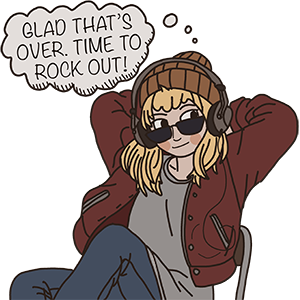
as1.e2 – The Picture
as1.e2 – The Picture
Use the arrows or swipe/drag mouse to navigate pages.
as1.e2
The Picture (Loudon Wainwright III)
By Wednesday, I felt done with first grade. Whereas I always thought most kids had fond memories of it, I… did not. I made no friends, I stayed shy and needed time to adjust, and Ms. Gardener wasn’t one of those “fun teachers” you wished you could return to and spend one more day with. I decided to move on halfway into the day, but had few chances to close my eyes and concentrate as one lesson blended into the next.
At least until I got my lucky break, when she dimmed the lights and put on the first educational film I likely ever saw at school. A few of my peers squealed in delight when she wheeled over the big old tube TV to the front of the class; to them, television in school must have still felt like a forbidden, special thing.
As some early 1980s production with puppets espousing traffic safety captivated the class, I took the opportunity to try and advance time a little and move onto second grade. Ever since waking up this morning, I had a growing sense that I really could jump around in time. Like sight or hearing, there was something innate—and new, and trying to put the feeling into words would be like describing colors or sounds to someone who had never experienced them. I also expected it would take time to control my new ability with precision, but that didn’t matter just yet. As a six-year-old, my power to make any differences in the world was limited, and I didn’t want to idle and wait around.
I thought about second grade, by visualizing the teacher and the time Liesel and I first met. And, suddenly and with very little sensation, light was on my eyelids. Once I reopened them, I found that I was in still in a classroom, and for just a second, thought nothing happened. Until I saw a whole different collection of hairy heads in front of me, and my cool, if not slightly lovingly dorky, second grade teacher. Mr. Landis.
“Okay, class,” he said, and turned to face us after writing ‘How do Plants Grow?’ on the chalkboard, next to a bad drawing of a little sprout. “It’s time for a group project, so let’s push our desks together, and I’ll put you in teams of four. Now, I always like to meet new people, so how about we mix it up a bit? Once we have six tables made up of four desks each, I’d like you to sit with students you don’t really talk to or know that well, okay? I only have six plants, so we need to be gentle with them, all right?”
Always excited to do something out of the routine, my new class left their seats, shoved their desks together, and trusting that no one would mess with their left-behind backpacks, got to picking some “lab” buddies to hang out and learn about plants with. Remembering right away that this was when I first hit it off with Liesel and how vitally important the moment was to my life, I did my best to locate her in the crowd and get a spot at her table before I lost the chance and messed things up between us.
She stood out, though—quite easily. She was always one of the taller kids in a class, with long brown hair, a cheerful disposition, freckles, and a single barrette in her hair. I went right over and joined her; she already looked glad to see me despite us only having shared this class for around a couple weeks. With us were two boys, their names I sort of shamefully couldn’t remember. But it wasn’t like this was also their moment.
“Hi,” she said. “Um, you’re Maisy, aren’t you? You’re usually alone at recess?”
Yep, that was me, all right. “Yeah,” I responded. “You must be Liesel.”
Her eyes got a little bigger, and she replied, “Wow. No one ever says my name right. Did you used to live in New York City or something? I like your beanie.”
“Chicago,” I corrected her. “And thanks.”
Reminding us to be careful with plants he had grown in his own backyard, our teacher set down the baby we were supposed to study. It was a small thing, trying to thrive as it sat in a layer of topsoil within the bottom half of a twelve-ounce soda bottle.
Designed to be a microcosm of layers, under the soil was gray dirt, and under that were pebbles. Looking back now, the hapless teacher from Beavis and Butt-Head, Van Driessen, was like a caricature of Mr. Landis to a T. And the guy was so chill, I wouldn’t have been surprised if these little plants weren’t the only species he had cultivated.
“Okay, class, let’s study these sprouts carefully,” Landis said after returning to the front. “What’s the first thing we notice in the bottles? I’d like to see some hands.”
Attentive student that she was, Liesel raised her hand and said after being called on, “I like getting to see the roots! I didn’t know they could go down so deep.”
“Good observation, Ms. Ottokar. Yes, the growth of the roots seems random, but they tend to extend to where the soil is more moist, or has more nutrients. Growth takes energy, so the plant wants to be as efficient as possible. Efficient means to use our time wisely, doing as much as we can at a good speed. But it doesn’t always mean rushing. Now, what’s something we notice about the different layers in the bottle? Yes, Sarah?”
Liesel turned to me and smiled again, always eager to make a friend. Little did she know that I would end up being her best one within the year as she asked, “So, Maisy, I think you told the class you like music, right? Didn’t you make a little rubber band guitar for that project last week? That was so cool. What kind of music do you like?”
“Oh, um… Well, I grew up on folk, and it’s sort of my own roots. But I respect all genres and will listen to anything once. Any form of artistic expression is…” I trailed off when I realized I was losing her. What was I doing? What second-grader sounded like that? “Er, I mean… I like rock and roll. And how about those New Kids on the Block?”
She smiled again. “Yeah, they’re good! If You Go Away gets stuck in my head.”
I was sixty, I reminded myself. Making friends as an adult is tough; we either overcomplicate the process, or we’re too nitpicky about other people. Meanwhile, kids could get lucky and make life-long pals with a simple, “what’s up?” at the right moment.
I knew I couldn’t risk screwing up making my BFF. I never should’ve come to this day in the first place, not even just to relive it. After thinking about all of this for a few seconds, I closed my eyes and got out of there, assuming that the non-time-traveling version of myself would take over and do it right. It’d be like switching to autopilot, only here, I was handing the keys back to the original me that carried me all the way to 2045.
When I opened my eyes again, I was surprised by the computer inches from my face, with a grayscale screen. I was in the lab, in one of the wings of the school library. A quick look at the date on the Mac System 7 desktop told me that I had jumped into mid-September. I had aimed for two weeks to give my burgeoning buddyhood with Liesel time to form, but evidently I had overshot by about a month. Fortunately, Liesel was at my side with her own Performa 200 all-in-one machine. Still smiling at me.
“Computers are hard, aren’t they, Maze?” she asked, already using my nickname.
“Uh… yeah. Sure are…” I murmured as I situated myself by looking around and trying to remember this day and class I had leapt into rather randomly.
Rubbing a temple, Liesel added with some frustration, “My mom has this really cool Yamaha keyboard, so I thought maybe I’d know how to use one with letters, but…”
I opened a new text document on my screen, and typed out with just my index fingers in an attempt to teach but not impress, “Typing isn’t too hard, Liesel.”
“Easy for you to say!” she huffed. “You wrote that so fast! How am I supposed to memorize where all the letters are? Maybe if they were in the normal ABC order…”
“Okay, now let’s try making a new folder on the desktop,” the lab teacher and relatively young Mr. Parrow instructed from the front of the class, next to a projection of his computer’s screen—which was fairly cutting-edge for the time, thinking about it now. “Do you remember how to rename folders? Let’s call this one… ‘Art.’ And what we’re going to do next, is open MacPaint, make some drawings, and save them in there.”
“Mr. Parrow!” a known tattler—I think her name was Kylie—said at the same moment she raised her hand. “Pete just installed Battle Chess again! I saw him do it!”
Mr. Parrow groaned. “Pete, I told you to stop bringing your games from home. It’s great that you know how to install software, but it’s not fair to the other students.”
Pete argued, “But I’m bored. I know all this. And besides, chess is educational!”
An idea struck me then; one that likely sprang up from a combination of me typing into a document, Pete installing stuff, and the memory of floppy disks. Maybe this detour into a computer lesson was fortuitous after all. I wasn’t at all certain if I had the option yet to use a thing we’d eventually take for granted, and get annoyed by, but there was someone in this lab who knew about the contemporary computer landscape.
“Mr. Parrow?” I asked him before I would’ve interrupted a just-restarted lesson. “Is there a program that can make it so you need a password to open a disk?”
I heard a few kids murmuring about my question, with someone asking what this ‘password’ thing was. Mr. Parrow answered, “What… would you need that for, Maisy?”
“Oh, well… I thought maybe I could keep a journal on my computer at home that my older siblings couldn’t peek at. So… are there any password… programs?”
“Wow. I’m a little impressed you’d know about them,” he said, as Liesel stared at me with big eyes again. “Um… see me after class. I might be able to help you with that.”
“Maze, what was that, back in the lab?” was the first thing Liesel asked me as she took her seat at the table we shared at lunch and plopped down her tray of cafeteria slop I had no real interest in tasting again. “You’re usually so quiet and don’t like raising your hand, and all of a sudden… bam! You’re asking about ‘passwords?’”
I tried to shrug it off after biting into my brown-bagged apple. “My brother and sister keep looking at my journal, so I just thought…” What I was thinking was how this was becoming a nuisance; each time I ‘took control,’ it meant I was mostly overwriting my kid personality with my adult one. Why’d I have to be socially awkward at this age? Still, I needed some sort of excuse, so I put on a determined expression and shifted my tone. “When I really want something, I’ll be brave and ask for it. That’s all it is.”
She still looked surprised, but she did relax a little before replying, “I guess you’re a bag of surprises, Maisy Wilkins. Maybe I don’t need to stick quite so close at recess to protect you from those bullies that are mean to the quiet kids. Well, I learned about passwords today. Once my brother starts walking, he might go after my journal, too…”
I gave her a confident small smile, as if to try and convince her that I could have a spine sometimes, and hopefully make any future “incursions” less of a standout. The other three kids on the opposite side of our table gave me glances of their own, but quickly lost any interest in my multi-layered personality and went back to eating.
A few seconds later, someone new joined us. While I hadn’t exactly remembered much about her, as soon as I saw the nerdy young girl in pigtails and pink, oversized glasses, some memories of our original interactions growing up did return to me.
“Hi,” Heather Bowers piped, holding her tray nervously and revealing that she had been one of the few to pick the burrito today. “Um, you’re Macy and Lisa, right?”
Liesel let out an agitated but not angry snort, replying, “That’s Maisy and Liesel.”
“Oh. Sorry… Is it okay if I sit with you guys?” she asked. I gestured to the open seat next to me, and after looking far too relieved about it and joining us, she inquired, “I was wondering about your knit cap. That’s what you call it, right?”
I smirked. She was in Lab, but wasn’t asking about passwords, so I could assume we had talked like this before. “They’re called a lot of things, but ‘beanie’ is fine.”
“I see… Do you wear it ’cause you’re cold? I’m thinking of trying one, so people look at something other than my big dumb glasses, but it might make my head hot…”
Truth was, I always thought “beanie” was a dumb word, but everyone called it that, so I got used to it. And they were nice to wear in Chicago winters.
I grinned, and at the risk of sounding too precocious again, replied, “I just like the feeling of it on my head, Heather. It’s not a fashion statement, or something only I can do. Go for it. See how you look in the mirror, and ignore any bad comments from others. If you like it, too, you’ll know. Um, but probably don’t wear it over your ears; it’ll smoosh them against your glasses and make them hurt by the end of the day.”
She looked at me curiously and thoughtfully. “How would you know that… Oh! You must’a worn sunglasses with beanies before! I bet you looked really cool like that.”
“Yep, that’s me,” I said and leaned back in my chair as Liesel gave me another of her stares because I wasn’t acting like myself. “I’m real cool. Well. Sometimes.”
Man, did I miss simple, trivial conversations like this. Being a kid had its benefits.
“Ya know, I don’t think I’ve seen you without it yet, Maze,” Liesel noted. “Even when I’ve visited your place, you kept it on. Are you hiding something under there?”
I gave her a little eye roll, and went ahead and yanked it off to reveal… just more light blond follicles, in the form of messy hat hair. Liesel seemed oddly disappointed.
Then she looked around and cheekily said, “Where’d she go? She was right here.”
A couple hours later, the bell rang and another school day ended. Liesel gave me a wave and ran off towards the parent pickup area, leaving me alone amid the crowds for a moment until River inevitably found me. This being my first time finishing a day of second grade in a long while, I looked around to see if anything was different about kids in 1992—not that I was expecting anything distinguishable. That was, until I noticed a vaguely, distantly familiar head of messy brown hair hiding behind the main entrance stair stoop. Memories of someone else began to return, but I didn’t quite have a name.
“Gah!” an antisocial-looking boy wearing a Maui and Sons shirt exclaimed after I apparently startled him. I was never sure what that brand or company did or made, but I always liked the colorful shapes on their logo. “Oh, it’s you, Maisy…” He shuffled his shoes on the pavement as he hid from everyone. “Hey, wanna hear about my problems again? You seem to be the only who will listen instead of telling me to ‘stop whining.”
“… Morris… Prescott?” I murmured as I tried to recall more about this kid.
“You remember me? The ‘jaded’ first-grader?” He sighed. “That’s what my big bro calls me, anyway. So, everyone was talking in Mr. Byrd’s class again. Except me, of course. He tells us to be quiet, and I already am. But, no one else wants to obey the adult.
“Nah, they act like they can win that fight. It’s dumb to disobey adults, ’specially teachers! They got all the power! Everyone keeps yapping, so he makes all of us write twenty times on paper, ‘I won’t talk when Mr. Byrd tells us not to.’ I also do this lame punishment thing, ’cause what choice do I have, but I write ‘don’t’ instead of ‘won’t,’ because I actually listen to the teacher. We hand ’em in, and I’m thinking he’ll see what I wrote and, I dunno, maybe wink at me? Or tell me sorry for making me write it, too?”
I was at the edge of my seat with this story and needed to know how it ended, but I still drew things out by saying, “Common punishment technique. Used in boot camp, too. Penalize everyone to try and get them to self-police each other.”
“Yeah right! What am I gonna do? Go around telling other kids that they should be quiet? They’d laugh at me and call me a teacher’s pet or something. Anyway, Mr. Byrd didn’t even look at our writing! I saw him just throw them all away. Argh, why are these punishments so stupid? I don’t talk in class, so I didn’t learn anything!” He calmed down and breathed. “That feels a little better, though. Thanks for listening, Maisy. It’s nice having a listener. Everyone else just says I ‘complain too much…’ Man…”
“No problem, Morris,” I assured him. “Ya know, you could always try writing a song. A lot of people have shared their grievances through music.”
“Grievances? I dunno anything about music. I don’t even know what kinds I like.”
“Well… Try listening to the radio. You’ll find out eventually.”
As Morris may have considered this, River found me and did the big brother gaze that told me it was time to get on the bus. I wondered how his day had gone.
Back home, I quickly got bored with the cable TV shows River was surfing and decided to knock out my homework at the dinner table. Or at least set up the workbook, sharpen a pencil, and get my “other self” to take care of it. I had no reason to ever do it again myself. But before I skipped ahead again, I thought about going backwards in time like Charlie had, which I’d yet to try. Wondering how far I could leap, I closed my eyes and visualized the day we moved to the apartment, which might’ve been neat to see.
In an instant, I was transported somewhere noisy. I opened my eyes to find that I was even smaller, and seated with a cup of soda as two mediocre-looking pizzas were placed at a table I shared with my family. Wherever we were, it was full of loud kids and tired parents, many of them wearing sweaters. Had I gone to some place and time where it was cold out? Ahead of us was a stage. With curtains. Which had a logo for…
Oh, no. I hadn’t aimed for a time in particular, yet still really went and screwed up.
I had revisited one of my worst memories. This was a Showbiz Pizza Place, during its waning days. Near me was a naïve younger River, impatiently and foolishly waiting for the show to start. I closed my eyes to try and leave, only to hear Olive and then my Mom say, “Maisy, you’re going to miss it! Don’t you want to see the singing animals?”
No, I did in fact not. It wasn’t the creepy animatronics that bothered me—I had always found that eventual horror fad silly—but I hated the music. This was a business that remade classic songs, adding another layer of commercialization to them, and had soulless robots sing in an effort to entertain those who, what, had no better options?
Huh. Now that I thought about it, I could probably trace a direct path from this traumatic moment to me despising the rise of AI-generated music in the 2020s.
The curtains parted, the house lights dimmed, and the spotlights hit that ugly mechanized animal band with the poorly-maintained mouths that could barely move correctly. The bear on the banjo, the gorilla on the keyboard, and the rat, wolf, and all their other little friends greeted a crowd that, for some reason, clapped for machines.
“Hi, folks!” Billy Bob Brockali’s over-tuned voice blared. “Wow, thank you for coming out tonight! We’re Rock-Afire Explosion, and I’d like to introduce my posse with one of our favorite songs as you enjoy your pizza. And a one, and a two…”
The band began blasting a bastardized version of Do You Love Me, which jumped right into the loud part; no lead-up or anything. Olive immediately cringed, and poor River covered his ears. I’m sure I originally did, too, but now I was focused solely on getting out of here and returning to some quiet homework before the next song started.
Fortunately, I was able to do just that—though I skipped right to another family dinner in the apartment a few hours later. As the tune echoed in my head, I realized that I learned something good from the incident: Royal Valley never had a Showbiz Pizza Place; I’d only gone to one in Chicago, in winter, meaning I had access to my old house.
But I didn’t try going backwards again right away. It felt more difficult to begin with, and I needed a recovery period after the Showbiz Pizza incident, just like the first time. What I really needed to do was talk to Charlie some more. Recalling that I’d been sick once or twice early in second grade, I began the next morning by scouting ahead.
Getting used to time-jumping, at least in a forward direction, I “scanned” every other weekday morning. I didn’t have to go far. On a Thursday in early September, I arrived at a moment in time when I was eating my Pop-Tart with a sore throat, and felt miserable overall. It only took one look from my mom to get some sympathy from her and my chance to stay home. That meant Olive had to use a sick day of her own so she could stay and take care of me; she did work a minimum-wage job, unlike my parents, so it made sense. And it wasn’t like my nasty little cold was something I introduced to the timeline, so I didn’t have anything to feel bad about.
The only change I would incur on the day was convincing her to bring me out to Desert Tree again, which wasn’t hard. It seemed she had come to like it, too. Enough to make herself believe a visit there would “lift my spirits” and help with the illness.
“Charlie!” I shouted out from the fence, like I’d done over a year ago. Only this time, it was with a hoarse voice and between coughs. “Charlie, come over here!”
Olive was actively watching me from her driver’s seat, but there wasn’t much I could do about that. I’d just have to come up with some kind of excuse for why I was talking to a random boy who went to a distant school I didn’t attend.
Charlie, however, wasn’t cooperating this time. It took multiple shouts—which my throat did not appreciate—and at first, he only looked at me and then back to his buddies at the playground. After my tenth shout, it must’ve dawned on him that I wasn’t leaving, so he finally grumbled something to his friends and ran over.
“What do you want? Do I know you from somewhere?” he asked me.
I was taken aback. He could be a jerk, sure, but… No, wait. If he wasn’t messing around with me, I might’ve already had an idea of what was going on. But I couldn’t just leave now. Not when the stars had aligned to get me out here at the right time.
“Charlie, it’s me. Maisy. Don’t you remember?”
He studied me, looking critical of my beanie in particular. “Uh, I don’t know you. Why would I hang out with some weird girl? Leave me alone. You’re harshing my vibe.”
With that, he turned and started walking away. I couldn’t believe it. What did I have to do, go back and revisit our first chat? I could spend hours trying to return to that little point in time. With a sigh, I flipped around and got to shuffling off.
“Maisy!” he suddenly snapped, about ten seconds after he rebuffed me. I turned back and saw him at the fence, grasping the metal diamonds with his little hands. “I’m here. You’re lucky; I was just a few days away. New memories take time to reach us, and I suddenly remembered you paying me a visit and jumped back.” He groaned. “I wasn’t ‘in there’ just now, so you were talking to the non-time-traveling version of me. Yeah… it gets weird, the way memories of our ‘normal’ selves blend into whoever we are now.”
“Uh-huh,” I said and rubbed at my headache. “I had a free day, and I thought—”
“Free day?!” Charlie winced and raised his shirt collar over his mouth and nose. “Is that what you call it? You sound horrible! Geez, what are you sick with?”
I scowled as much as I could without further hurting my face. “It’s just a cold! We gotta find a better way to meet, Charlie. Maybe some way to schedule get-togethers? Not like cell phones are everywhere yet… But what about email? Like, using accounts only these versions of us know. When do you get internet? I think… it’s 1998 for me.”
“Um, ’97, maybe. I’d give you a home address, but then I’d be worried about you just dropping by at random. Look, your school probably has half-days on days we don’t. Why don’t you figure out the schedule on those, then come back to right now sometime and give it to me? That should work for meet-ups, right? Anyway, what do you want?”
Knowing I needed to be efficient with my time, I asked, “Got any tips for going back? It’s not as easy for some reason. I ended up somewhere I… didn’t want to be.”
Charlie smirked and put his hands behind his neck coolly. “Yeah, it’s harder. Not sure why. Maybe when we go back, it’s ’cause it’s to someplace more nostalgic, and the thought makes us too excited? Or it feels even more impossible than skipping forward?
“I dunno for sure. We spent our lives thinking time travel’s impossible, so, could be our minds see it as more unnatural. It just takes more concentration. But if you’re scared or your heart’s beating fast for some reason, it makes traveling really hard.” He looked up at the sky. “Ya got me wondering again why I arrived at the place and time I did, when I first used the machine. There’s gotta be a secret there, because I wasn’t thinking at all about my ‘landing spot’ when I first went back. Where’d you go to?”
“My bedroom. First day of school… Walked in on my family eating breakfast at the table,” I said with a long sigh. “I mean, it’s a memory that stood out and I would’ve wanted to revisit eventually, but also not really my first choice. If I could’ve chosen.”
“Interesting… Thanks for telling me.” He saw me staring at him, and frowned. “Er, sorry, Maze. I’m not going to tell you where I went. At least, not yet. It’s kind of embarrassing. Sooo… what else did you want to chat about?” He looked around at the houses near the school. “Do you, uh… like coming out to Desert Tree?”
“Sure. It reminds me of my neighborhood in Chicago. Our house there was little, but it had character. When I was a kid, I didn’t get why we went to a smaller city, and yet switched to the apartment life. I had no idea how bad my parents’ debts were until they told me, when I was applying to Royal U…” I scratched my neck and added, “Come to think of it, they’ll start their three months-on, three months-off timeshare jobs in about a week. The memories of just me and my sibs at home are about to start getting made.”
“You should tell your family you can time travel. I tried it, and then did things to prove it to them. The freaked-out reactions I eventually got were pretty funny.”
“Hm, yeah, I don’t know. You undid all of that, right?”
“Oh, for sure. Knowing my uncle, he’d likely turn me over to the government eventually,” Charlie said, his eyes noticeably flicking back towards the playground. “By the way, Maze, you should know something else. One of the kids over there—that goofy, hyper one on the fort with the baseball cap—he time traveled, too. Before I ever did.”
“Huh? Wait, seriously?! It’s not just the two of us?” I looked past his shoulder. “Who is he? And is he… ‘in there,’ like we are right now? Should I talk to him?”
Charlie chortled. “He’s never ‘in there.’ Brain joke, sorry. Nah, he and another guy were the ones that started the whole project and vanished in the accident. You should be aware of him, but just… leave him alone. You two probably wouldn’t get along, anyway. He’s, like, 95% about pop culture, and annoying about it. Name’s Wes Colton.”
“Colton? I think I vaguely remember him from college,” I said as the bell rang.
Before heading in, Charlie said, “Have some fun with your gift, okay? It is fun.”
Unlike him, having “fun” wasn’t the first thing I wanted to do with this power.
“Ready to go home?” Olive asked me when I got in her car. “Who was that boy?”
“Just someone I’ve seen around…” I murmured. “You know. Here and there.”


Not wanting to endure the miseries of being sick anymore, I easily jumped ahead to a big moment in my young life, and one I’d never forget. It was a Sunday, a bit over a week later. My family was gathered at the pre-security area in the modestly-sized regional airport, where a mural of the city welcomed visitors. The place had been built in the 60s and saw some refurbishing in the 80s; the decade in which its stylings seemed eternally frozen. The inside of the main terminal always did remind me of an office building lobby, with fake plants, wood railings, beige carpet, and indoor fountains.
“Well… this is it, kids,” Mom said after one last look at the array of fuzzy CRT monitors showing up-to-date flight information. She then told a tearful River as she gave him another hug, “I know, sweetie, it is a long goodbye, but three months will pass before you know it, and we’ll be back in time for Christmas.”
I was certain I had cried, too, originally. In fact, when I “warped” in, I did have moist eyes and a lump in my throat, but my emotions were subdued the instant I was no longer a little kid anymore. Olive, on the other hand, looked fairly excited that she’d be getting a chance to call the shots for twelve weeks and be our guardian.
“Now, Olive, don’t be afraid to call,” Dad reminded her. “It’s long-distance, but the company will partially cover the cost. We’ll be in New Zealand until November, and after that, the east coast of Australia before we can come home. But remember the time zones. Oh, and don’t forget that River has his Little League try-outs next week.”
“I got it all written down, guys, I promise!” Olive assured our folks.
“But you’re going to miss Thanksgiving…” River said with a sniffle.
“I know, Rivie,” Mom replied, “but your aunt and uncle will visit instead. And you know how good of a cook she is.” Mom gave Dad a nod after he showed her his watch. “And, Maisy… stay sweet like you usually do. Have a Christmas wish list ready by the time we get back, okay? We won’t have much time left for shopping by then.”
I smiled, nodded, and accepted further hugs from both of my parents before they left, giving us more waves as they disappeared into the security line. I had no idea what their jobs entailed yet, or that it’d be a point of contention later on. When I found out what timeshares actually were as a teenager, I couldn’t believe that a couple who used to play folk and classic rock for adoring audiences ever chose the kind of career they did.
“Bye…” River muttered once we were on our own, and put on a brave face.
“Well…” Olive turned to us and grinned playfully. “Looks like I’m in charge now. And my first ‘decree…’ Is that we get some airport Burger King food!”
River looked up at her, then to me, then to Olive again and just said, “Huh?”
“Hm? Buddy, don’t you remember from when we arrived in Royal Valley? This airport has a Burger King. I just thought, you know… I could treat you for dinner. How often will you get to eat at a fast-food place where you can watch planes taking off?”
My brother’s eyes lit up, and he exclaimed, “T-that sounds cool! I thought we were just gonna go home and have sandwiches or something, um… boring.”
Olive stared at him rather flatly and replied, “I do happen to know how to make more than just soup and sandwiches, Riv. And I’m going to cook you both things over the next three months that Mom and Dad would never make. And you’ll like it.”
We both knew Olive was joking around, but River still looked at me and gulped.
We had our first meal out with Olive as the boss, at a Burger King table as planes pulled up to or departed gates past a glass wall during sunset. It was a core memory. The feeling of a moment plays a part in whether or not it’s etched permanently in your brain, sure, but often times the visuals from a time and place do, too. While sunset colors were a common artistic motif in the 1980s and early 90s, it was likely this moment that always makes sunsets remind me of the decades. I could say it also represented the dusk of my early childhood, too—even more so than the move out of Chicago. Things will change.
I looked at Olive, happily sipping a Diet Coke, nibbling at the fries River got in his kid’s meal, and eating a burger with no cheese—which I’m not sure I’ve ever done.
We weren’t big into restaurants or fast-food places, and while I never considered myself a “chicken nugget kid” growing up, Burger King’s were straight fire for me at this point in my life, no sauce needed. My jam. Eating them again, the way they used to be, after having not for decades, was another anchor that brought me back.
“Hey, Olive?” River spoke up as he checked out his new Goof Troop Max bowling ball toy. “What exactly do Mom and Dad do for a job now? I don’t quite get it.”
I studied Olive, gauging her response in a way I hadn’t originally, to try and see how she saw it. But she only replied plainly, “They help people find vacation homes.”
“Ooh… That sounds kind of nice, I guess,” River said, still having no real idea.
One of my favorite photos was the one atop my mom’s piano, which was still on display in my 2045 apartment. How often does one see a Polaroid picture behind glass? They’re square, tend to have faded colors, and aren’t a natural first choice for framing.
Nevertheless, the shot of me and River in the Sears Tower observation deck, on a foggy day that left other buildings as shadows in the mist, was a one-of-a-kind treasure. He was five, and I was three. He wore a Cubs baseball cap; me, one of the few dresses I ever owned. Our whole lives were ahead of us. I don’t remember the day itself, as I was just starting to form memories. And yet, it’s still a sentimental photograph. Why do we get so nostalgic for times and places we don’t even remember? It’s strange, isn’t it?
But enough thinking about the past while I’m living it. Eating fast-food made me feel a little unclean afterwards, so I went over to Olive, who was doing some paperwork at the dining table—maybe signing documents pertaining to her being the new head of the household for three months, I was never sure—and tiredly made my request.
“Hey, Olive? I’m ready for my bath. You can sit on the toilet lid and read one of your mystery books again. Or even, um… work on your ‘homework’ in there?”
“Hm?” She looked up, then down again and said nonchalantly, “Maze, I’m busy. In fact, I’d like it if you and River shared for a while. He’s old enough to watch you.”
I instantly felt an avocado-sized pit in my stomach. How did I forget about this?
“Um… N-no, that’s okay,” I said nervously. “I mean, I guess he can be on the toilet reading his sports magazines instead, but, like… we don’t need to… share. Ick.”
Olive sighed. “Maisy. We live in a desert valley. Mom and Dad are still paying for the place, but I have to cover the utilities while they’re gone, and baths are expensive. I also wish they could’ve gotten a shower installed before they left, but the apartment’s so old, that it turned out to be a bigger project than they expected. So, please just take them together for now, okay? You did when you were younger. You’re family, so it’s fine.”
Crap. I was already too stressed to skip all this. Come on, Olive! See some reason!
“But I’m seven!” I argued. “I can do it by myself. I’ll keep the water low, okay?”
Olive dropped the pencil, stared at me, and unleashed the bomb. “Did you forget Mom’s story? About how Aunt Judith almost drowned in their family tub? She was eight.”
Ack, a tough one. The last weapon in my arsenal was my famous scowling glare.
But while it had gotten me out of other scrapes, against Olive… it never worked.
Kids talk about a lot of things, both while being one, and later on after they’ve grown up and are reminiscing about childhood. But there’s some stuff we tend to not talk about, like the fact that sometimes… you just have to take a bath with a sibling.
Thankfully, somehow, I got through all fifteen minutes of it, without me calming down enough to time-skip far away. Never so glad to be back in pajamas, I brushed my damp hair while I stared into the bedroom mirror and River dried his with a towel.
“You didn’t have to keep your eyes shut and only say ‘mm-hm’ to everything I said,” he muttered. “That was no picnic for me, either, but you made it even weirder.”
River might’ve found my behavior a little rude, however he didn’t know I was a childless adult inside, so kids not in stitches weren’t exactly something I felt comfortable thinking about, much less seeing. I didn’t actually keep my eyes closed the whole time, though. Eventually, I did stare straight ahead instead, at the toilet where Olive normally sat while supervising—which I didn’t mind nearly as much. Thinking positively, at least the water was nice and warm, and the vintage tub was in remarkable condition.
“That was so humiliating,” I grumbled, at the risk of not sounding my age.
“Geez. I didn’t even see anything. Sorry you hated it. Is it just because I’m a boy?”
“Not even. Riv, it wouldn’t be any less embarrassing if you were my twin sister.”
“Wow. Okay…” He shifted tone and said, “By the way, here’s that baseball I mentioned that I bought on Friday.” He brought over a beat-up old ball. “It’s signed by Frank LeMonte. He’s… average and plays for the Mariners, but guess what? He grew up and played here in Royal Valley. That’s pretty cool, huh? Remember me telling you about how the third-grade classes and up get a student-run secret store during recess? Yeah… Is something else up? You look worried about more than just having to do that again.”
“I’m wondering how power-hungry Olive will get. This could just be phase one.”
“Erm… I’m, uh, actually kind of scared about that, too. Heh. But, you know, you could always talk about stuff with your eyes closed to make the time go by. I’ll listen.”
“Yeah, great. Talking about my feelings with nothing on. I’ll turn into a hippie.”
“Hey, doesn’t Mom like to say she was one of those for a little while?”
Once my hair was dry, I made a point of going into the living room and giving my sister a solid, quiet stare as she settled in to watch an old episode of Columbo. It was the least she deserved. Of course, she just stared right back. She was hard to intimidate.
Monday, the next day. Recess. While I had skipped around through a few already, I wanted to experience one in full again. They only lasted forty minutes, but what a truly special thing they were to us. They provided a way to burn off excess energy, forget about the drudgery of schoolwork, and meet new friends across the entire second grade student body. If we held onto it—as in, even adults at office jobs got some time off in the middle of the day to just hang out and socialize somewhere, whether indoors or at a park—I wondered if the world might be a noticeably better place.
As over a hundred kids flooded out of the halls and onto the playground, I went over to check on a certain hatch in a corner of the school building, seemingly locked up tight. Next year, our underground store would be run from there. But, not yet. Second-graders apparently didn’t have enough experience or acumen to run an illicit pawn shop.
“Ah, it’s cloudy for once,” Liesel sighed contentedly. “Maze, how about a walk around the playground? I’m getting tired of always waiting for a turn on the swings or for there to be room on the fort, or even watching the fights that break out. Sometimes it’s more fun just to see what everyone’s up to, you know?”
That was what I wanted to do anyway. We began our journey, the starting point being the watchful old crone of a playground monitor, Mrs. Sundren. She had the eyes of a hawk, but at her age, preferred not to move around too much, so the further one got away from her, the more likely they were to encounter more questionable behavior. Like dare-taking, card games, and most flagrant and risky of all, kids playing on a Game Boy or using a link cable to do some two-player rounds. You always had to be sneaky about it, though, and stay on the good side of known tattlers like Kylie Smithson. It was the law of the jungle out here, but there was still an order to the chaos.
The playground wasn’t too big, yet there were some places to hide among its trees and big old truck tires—this being an era where they were still sometimes used for cheap filler to jump around on or relax inside of. The fort was impressive but out of date, as it was made of wood that occasionally led to splinters and metal that broiled in the sun. Its rope bridge was an interesting feature, though kids often got tangled up in it.
We had a noisy merry-go-round, too, which I swear I hadn’t seen on playgrounds anywhere for decades. There was also a basketball court, and a metal climbing dome that kids often stretched jackets over in segments to make shady spots with on sunnier days.
Touring the grounds was a good way for me to take stock of the entire collection of students I shared a graduation year with—and to start coming up with a list of who would be important to my long-term plans, or at least play a small role along the way.
The first kid of note that we encountered was Cass McCormish, typically found at the tetherball court in second grade. She seldom played herself, but was a relied-upon score keeper and, knowing the odds of many players, even took bets on the down-low. She was a self-assured, peppy black lass who also happened to have come over from Scotland at the age of five, and always maintained a little bit of the accent.
“Hey, Cass,” Liesel said as we stopped nearby for a moment. “Is Wren playing?”
Cass stuck her hands into the pockets of her pink raincoat—she wore them all the time, which kept her clothes immaculate—and replied, “Aye, I think so. Came to class this morning with no sling for her arm sprain. She’ll be underestimated, so I changed her odds to match. But I’m telling ya… she won’t pull any punches.”
“Great.” Liesel checked Mrs. Sundren’s line of sight, and then took two quarters out of her pocket and slipped them to Cass. “Wouldn’t mind doubling this if I could.”
“Safe bet, I’d think,” Cass said, taking the coins and scribbling in her notepad.
I smirked. Liesel wasn’t big on risks, but did like what seemed to be a sure thing.
The next two we saw were Vera Lawson and Claudia Fitzgerald, the “pretty girls” of our grade who always dressed the best. But it was strange to see them apart, and still in their own little proto-friends-circles for the time being, as they would be forming a rather infamous mean girl duo soon. Not a problem for now, though, as the bug had yet to bite. They were smiling and looked happy with what they had for the time being.
As our walk took us to the fort, the big old centerpiece of recess, the first thing I noticed after the throng of kids all over the structure was the small line leading up to the shaded area underneath its tallest tower. It was here where the Kenyan adoptee Brady Joseph was allowed, at least in the court of public permission, to set up his little “advice” operation. He even had a sign hanging by string from a bolt on a support pillar, listing the rate for his sessions: ten cents per minute, with the first visit being free. It was more than Lucy charged in Peanuts, but hey, that was also an old comic strip in 1992. Inflation.
“Good luck, Henry. Tell me how it goes,” he said, dismissing an antsy kid who needed help with some minor troubles. “Next? Yes, Pete… What is it this time?”
Both of us curious about what the video game-loving Pete Dunlap needed help with, we slowed our pace and listened in as he replied, “I did it, Brady. You said it wasn’t a ‘good idea,’ but I totally started asking kids to call me ‘Player One Pete,’ so they would all know I’m the best gamer at school by a mile, and guess what? No one laughed!”
“Uh-huh. I see. I don’t believe I told you that they’d ‘laugh,’ Pete. At least, not in your face. Tell me, has anyone actually called you that, and if so, in what tone of voice?”
“Oh, who cares? The point is, I feel great about my new nickname. Are you sure you know how to give good advice? Because I think I’ve wasted about a dollar on you.”
“Not really a nickname. Look, like I’ve said before, my mom is a therapist, and my dad is a psychologist, so I know what I’m talking about. Can you say psychologist?”
“Of course I can! Psy… Psycho… Psycho-olala-sist. And I’m not paying you for this! I just wanted you to know I’m officially Player One Pete. Cool name, right?”
“Oh, brother…” Heather, next in line, remarked. “Hey, Peat Moss, the rest of us got actual problems. No one cares about your new name. Peat Bog.”
“Don’t call me that! Heather Bowels,” he countered, and got a disgusted reaction.
I would’ve liked to hear how the rest of the ragging went, but we were out of earshot by then. Next up, hanging out by the swings, was Enzo Deloria, whose claim to fame was a strange… “service.” He didn’t charge for it, but other kids liked it when he sat next to them in the cafeteria, or got the chance to take a whiff of his jacket.
“Oh, wow! It really does smell like a pizzeria!” a smaller boy said excitedly, and took another close, big sniff. “Yeah, that’s nice. I can almost taste the melting cheese.”
Enzo smiled and explained, “That’s because the fabric on this jacket here is good at absorbing smells, and every day after school, I hang it up by the oven in my folks’ pizzeria, just so I can bring the aroma of the city’s best pies to school. You should come by and have a slice, ya know? Cosmo’s, just off Main. We appreciate the business.”
“Do you think his parents have him doing that as some weird marketing thing?” Liesel postulated as we went by. “I wouldn’t mind having a class with Enzo, though. You know, just to see if he can make the whole room smell like… warm pizza. Mm.”
As we headed into the boonies, we walked by Luka Tsakonas, already the prince of the grade. The son of the Greek vice president of a company in the Torus Building downtown, he was handsome, well-dressed, and yet didn’t flaunt his fortunes too much.
One of the few kids on the playground who wore a collared shirt, Luka had his soft-spoken buddy Wallace at his side and was showing a trio of girls his collection of European football player cards. Not that they were what his own fans cared about.
“Oh, these are some of my favorites—look at these,” Luka said, holding up five sleeved rectangles of printed cardstock to the gigglers. “Paolo Rossi, Michel Platini, and Thomas Mavros—love these guys. These cards are hard to find in America, you know? Only one place in town imports and sells them. My best ones, I keep at home, of course.”
As we headed into the “wilderness” of the playground, as far as there could be some given that we were surrounded by office buildings on all sides, the beat changed again. A tempo flowed through everything, and everywhere. It was the sound of people interacting, the mood of a place or room. Close to center mass, where kids congregated, could either be Gershwin or metal demanding on who you ask. Further out, in smaller groups, you have jazz, where voices interrupt each other less often, and wait for a break in which they can slip in. Go out far enough, like the space where the trees cluster more tightly by the disused old maintenance shed, and you get into the solo acts; my old tune.
This was where we found Edmond Palmer, reading a comic book in the shade all alone, atop a big old truck tire that was the most distant piece of play equipment. It was about where me and Liesel would be turning around, but we’d lingered just long enough in his territory to draw his ire, so black-haired, brown-jacket-wearing Edmond glanced up from his comic, shot us an annoyed stare, and asked a question in his gentle way.
“Do you girls want something? You’re bugging me. I like being alone at recess.”
“We’re just walking, sheesh,” Liesel retorted. “What are you doing way out here, anyway? I don’t think I’ve seen you around before. Not with the others, I mean.”
“I just told you! Weren’t you listening? Why do girls always gotta be nosy…?”
It was Edmond, all right. A kid who always had his defenses up, made of steel walls. That were covered in spikes. Yet he was also central to my big plans, meaning I’d need to befriend him next. But, not quite yet. We’d share a third-grade class, so I had no reason to try and get close to him so soon, while we only saw each other here, or in the halls, or at lunch. He liked his space, but cross-class friendships just felt too distant.
Before returning to his comic, he looked at me and scoffed, “Heh. Nice hat.”
Deep down, from what I remembered… those walls protected a real teddy bear.
Back home, around an hour before dinner, I got into the hall closet again. This time, I pulled out the guitar completely in order to check something, hoping that River would stay too busy with his homework to notice. I kept the old acoustic upright and tried to see if I could wrap my fingers around the neck. I was itching to start playing—or practicing, at least, if I no longer had the muscle memory—but frustratingly, I couldn’t quite cover the entirety of the fretboard and reach all six strings with these little hands of mine. It was enough of an annoyance to elicit a groan, as the way I figured, the earlier I could start strumming, the better. I would just have to be patient.
As I was putting it away, however, I was reminded of something else important, which I could take care of. Under a fitted blue dust jacket was my folks’ Macintosh SE; a 1987 computer with a whopping 20-megabyte hard drive that they had gotten at a garage sale in Chicago, and used for about two years before upgrading to something newer. But it’d be more than enough to fit my needs, assuming the password software worked on it.
“Hey, Olive?” I asked her as she began early meal prep for one of her complex dishes in the kitchen. “Would it be okay if I set up the old Mac at my desk? For school?”
She looked down at me after opening a cupboard and replied, “Um. I guess so? Just get River to help you set it up, okay? That thing’s heavy. And only use new floppies.”
River perked up from his boring fourth-grader homework, tantalized by the prospect of doing anything else, and questioned, “Maisy likes to use computers now?”
Right… River didn’t start regularly using one until high school. But it was still an interesting enough development to get him to help me lug it into our room, and work together to lift it onto my desk, where it and the keyboard took up most of the space. I hit the switch on the back to boot it, and took out from my backpack a disk labeled Pass Pro v1.2 via Sharpie on a piece of tape. Mr. Parrow may have, gasp, copied a floppy.
“Whoa, are you… installing something?” River exclaimed, as his eyes stayed on all twelve inches of the grayscale screen and the application graphic thankfully showed up.
“Uh-huh,” I replied and clicked stuff. “This’ll let me put a password on disks.”
“Oh. To, like… um, keep a journal? Why not have a normal one? I won’t peek.”
I was seven, so I needed no better excuse other than, “Because it’s cool.”
I then cracked open a fresh disk, put my legs up on the chair, and politely shooed River away so I could type in private. After a knuckle crack, I began clacking the keys.

September 21st, 1992. This is the first journal entry made by a new Maisy Wilkins. To my other self, if you somehow guessed a long password that references something only relevant to me, or us, sometime in the distant future, this is your last chance to back away and not read this file. What I’m writing here isn’t for you. I need some way to keep a secure chronicle of events and my own thoughts, and right now, this is the best way. Close out, live your life, and maybe if this all loops and you find yourself in the right-now, you’ll remember our computer and what we did with it. Until then, bug off.
So, my life, and the people in it. Before I start messing with things and changing events, let’s start at the beginning, before I was born. My dad, Marlon Wilkins, was born in 1948 in Peoria, Illinois. My mom, Denise, a year later in the same town. They became friends in elementary school despite being a grade apart, and by high school, were dating and bonding through a love of music. They listened to their parents’ record collections, sometimes flipping over a half-dozen licorice pizzas in a single night, or so they told us.
Perhaps the first big milestone and trip they made together was in my dad’s first car, when he was 17, in an era in which kids grew up a little faster than they do today. I could never imagine making such a long drive when I reached that age. With fifty dollars between them, they went all the way to Newport, in 1965. Yes, they were in attendance at that consequential and infamous performance where Dylan went electric. But, the way they tell it, they were among the few that did not boo. Not because they agreed with his choice, didn’t see it as the death of folk, or weren’t worried that he’d just sold out.
They simply liked music. No matter its form, or who wrote or performed it. As long as the heart of the artist was in the song, they loved it, and being in the moment. Concerns about tomorrow, or where things were heading, wasn’t what they were about.
Two days after returning home, they began their band with several classmates. It continued to exist while they were in college in Chicago, and persisted afterwards on the local scene, performing both covers and original songs. Somehow, they kept the Great Lake Pirate Initiative alive all the way into 1985, when I was born. I never got to see them on stage, but they would often tell me it wasn’t my fault it ended.
I never knew for sure the meaning of their band name. If it had one.

On the Thanksgiving of 1992, we had our first feast without our parents. But Aunt Judith loved the holiday, and with Olive’s help… we actually had more and tastier food than before, and began a new tradition without Mom or Dad.
With the whole apartment smelling like roasted bird and warm bread, my mouth watered as my aunt cut me off some turkey and placed it on one of our special occasion plates that once belonged to my grandparents. She was a painter in San Francisco, where our uncle brought in the more consistent money at an architecture firm. They never had any children, and our only cousin, who I rarely met, was on my dad’s side.
I always associated jazz music with Thanksgiving because of Aunt Judith, who for some reason, burned through the old records in the family library during her visits. Davis, Monk, and Parker played softly among green beans and sweet potatoes, and what few memories I had of the Macy’s Day Parade ended this year, because she refused to have it on, calling it a “display of runaway worship of capitalism.” I mean, fine, I guess, but if you’re going to go down that route, you might as well dip into the whole “what, exactly, are we celebrating today?” self-reflection, as well. But we all liked the feasts.
“Thank you for helping, Olive,” Judith said at the end of our narrow table as her husband, a bit of a drinker, poured himself some wine. “River, maybe next year you can help out, too, hm? And Maisy—do us a favor, okay? Just… really love our food for us.”
I gave her one of my earned smiles, and we all dug in. Like they had before, the smells and tastes really brought me home, seemingly in more ways than actually being back in a physical sense could. How did memories come to have such power over us?
It was halfway through my meal, as I stared at an empty plate and prepared for seconds, when I decided it was time to try and see the old house, if just for a moment.
And when I opened my eyes, I let out a gasp as the onrush of fully immersive nostalgia hit me. I was lying on the couch in our little living room. Our small tube TV was playing some New Year’s Day movie marathon, and our 1990 Christmas tree was in the corner with its lights on, and no trace of wrapping paper torn off of gifts from about a week prior. I jolted up and saw our snow-covered front yard. To be able to go back this far, from my existence in 2045… It was like I’d arrived on another planet.
I went to the window in my stupid, kiddy footed pajamas and took a look at the Chicago skyline in the fog. This memory was precious. That’s why I didn’t linger.