
as1.e1 – Ghost Beside my Bed
as1.e1 – Ghost Beside my Bed
Use the arrows or swipe/drag mouse to navigate pages.
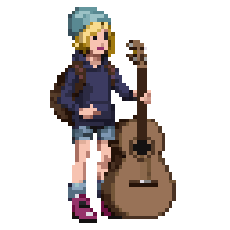
Another 90's Kid
This story can be read before, during, or after the original The 90's Kid Series
The reading experience of the first will change, however.
Aspects of Wes' story will be revealed early…
… and the truth about Charlie Pippin and King Arcade appear in Chapter 1.
If you're okay with that, or already read The 90's Kid…
Get ready to rock.
as1.e1
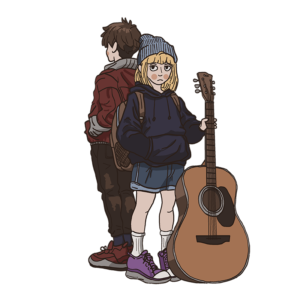
Ghost Beside my Bed (Altered State)
It was at the very end of our set—the last minute of our final song, in fact, when I did it again. I wasn’t sure what to call it, but it remained an ongoing shortcoming of mine. I didn’t see it as wanting to stand out, or stealing the spotlight. Maybe it was more of a “let’s just finish this already” type of thing. A form of impatience, or me stressing that we were about to run out of some nebulous concept of time. I was once again a tightrope walker who had maintained her cool and calm, until the very end when her legs began to wobble and she went tumbling down into the endless chasm below. It was the thrill of concluding a song. The vision of going home to a comfy bed. Maybe a complete loss of confidence at the finale as loud doubts barged in, screaming that you had actually been playing lousy all night, but the crowd and bandmates never had the guts to tell you.
Whatever it was, it happened again. We were playing Ghost, from Neutral Milk Hotel’s In the Aeroplane Over the Sea. It was a 1998 song, from a hard-to-define band that only put out two albums yet reached cult status. Why this one? I didn’t know. Why play anything? How do you decide a set? Why do we keep hitting the same places? Life for me had become little more than going through the motions. But there was an escape in making music. It transported me; took me out of the present, made the past and other people feel alive again. Nothing else mattered for those few minutes we rocked whatever joint we had a new gig at. But even then, I often found the ability to screw it all up by playing too fast, too hard, or out of tempo, and it made me stand out in the worst way.
“Thank you for coming out!” Richie shouted to our audience in the small venue, most of them filming the little concert with their phones like it was worth preserving. I could tell he was less enthusiastic than he would’ve been had I not choked.
This particular song turns into an instrumental hodgepodge at the end; the kind of stuff that can easily devolve into messy chaos if everyone wasn’t focused and playing at their best. Tonight, that wasn’t me. Samson, on the drums, didn’t seem to mind, but the older girl, Shawna—I think she was into her early sixties—was glaring daggers my way. She ran the keyboard, trumpet, and an antique theremin all at once, and here I was on second guitar making us all look like amateurs because I leapt off the tightrope.
The crowd, of course, probably didn't hear it. Royal Valley’s Club Clamor was an old place, and not the kind where those who had played with the pros or had the ear of one often visited. Most of them were buzzed or drunk, and they all shared a common and simple desire: to have some fun on a Friday night. To watch humans play something real, written by people, with no involvement from AI—or experience an arguably worse and tackier offense like lip-syncing. My blunder would be preserved on some corner of social media or YouTube, to be noticed by people I’d never meet, sure, but I didn’t care about that. What mattered more to me was letting down my friends and bandmates.
As our listeners broke up and staff began to wipe down the tables and clean off the old checkerboard tile, I unplugged and considered whether to apologize in advance, or wait for the reprimand. I tended to be proactive these days and get ahead of things. My aging heart didn’t like the stress, and I could no longer leave things unsaid.
“Rich,” I spoke up as I put away my trusty brown and black 2025 Stratocaster; the other partner I had let down tonight. “Sorry about the end, man. I botched it again.”
“Maze, I hardly noticed. It wasn’t that bad,” he tried to assure me, but he was just being nice. “I think you just need a different pick. That smaller one you’re using—you grip it too tightly; it’s unneeded strain on your muscles, which makes you tense.”
“I noticed,” Shawna huffed out. “There’s that toxic positivity again, Rich. She’s on rhythm, yet has a problem with time, always playing ahead of us like that. How’s she going to learn to keep in sync if you brush off her own criticisms? Least she knows it.”
He grumbled and locked up his guitar case. “That’s not toxic positivity, Shawna. They’re just words of encouragement. If she can identify the problem, she’ll get better.”
“I mean, we’re not playing places like Clamor to change the world here, Shawn,” Sam remarked. “We’re allowed to be a little less than perfect, aren’t we?”
“Sam, it’s okay,” I said with a sigh. “We should always try to be better.”
We finished packing up our instruments and took turns hopping off the stage. Sam and Shawna gave us their goodbyes and headed out the main entrance, but Rich instead went over into the side hall. I always knew that meant he was feeling nostalgic.
With my electric guitar protected and slung around my back, I followed him out into the corridor, made sometime in the 1950s. The building was nearly a century old, and it often made me wonder if the bricks somehow caught little memories of all the jazz, folk, and rock music that’s been played here. Perhaps, on some molecular level, the composition of the red clay was uniquely shaped by decades of sound waves.
“Five years, sometime this month, Maze,” Richie said and gave the photograph on the wall of the first time we played here, its placement memorized, a tap with two fingers. “I never thought the band would last this long… But I’m not sure if it’ll see a sixth anniversary.” He turned to me and saw my worried expression. “Don’t look sad. The internet’s fickle, and the current trends are, well, trending towards music that we just don’t really know how to play. Or that I think any of us would want to.”
I frowned, and a familiar feeling of emptiness began to grow in my belly. “People are always saying they want to see something ‘real’ these days, but then they just treat some hyped event or latest craze like the meme-of-the-moment and move on. To think, a functioning attention span used to be seen as a good trait. So… what’s shaping up to be the newest fad? Are we going into the year of ska? House? Traditional Indonesian? Hell, half the genres that the internet dictates are popular, are ones I haven’t even heard of.” I muttered, “They claim to want ‘real,’ yet they chase it through some algorithm.”
“Country. Early 2000s style and callbacks, to be precise. Yeah, I know,” he said after he saw me gag. “We’ll see what happens. Twelve months from now, we could be back to neo-folk or new-nu-metal again. Try to be optimistic, Maisy. We’re a lot more versatile than most bands. Just not… totally omni-musical. The trends are the final say.”
He headed out into the cool drizzle of the night, giving me one last wave as the bell of the side entrance door rang. I stayed a moment longer, gazing into that vintage-styled black and white photo taken when I was five years younger… but still too old, it seemed like. I had felt ‘too old’ for a while now, as if perpetually stuck at the end of all things. My history, too dense to fully remember. People and places, forgotten. I looked at the handwritten label for the photo, and could recall that day. The Bad Lizards. 2040.
I left Club Clamor at 9:15. It had been raining lightly for days, and a thin layer of fog had descended upon the valley. By 2045, the city had changed so much from the place where I’d grown up in the 1990s. A buzzing police drone, its red and blue lights flashing, passed by as it flew over Main Street, and would soon be the first to respond to some accident or crime further along. Holographic advertisements and storefront signs, while small, rudimentary, and reliant on the spinning blades of a fan-like device, called out to a deterministic future that people seemed to be creating for themselves, as they reached towards what sometimes felt like a cyberpunk-esque world. Club Clamor, being the time capsule that it was, had none of that; its marquee needed to be changed out by hand, with letters that could blow away on a windy day. Some people found that quaint, or antiquated, but to me, it just felt like the last vestiges of a more genuine era.
On the way to my car, I passed by—and briefly peeked into—a Robo-Tour VR center, which was always packed and stayed open late because of high demand and time zones. On its storefront window, it advertised that they were currently running visits to Tokyo, Rome, Queenstown, and Barcelona; always popular locations. The ten stations inside, which cost twenty bucks an hour to use, were filled with virtual tourists wearing goggles that connected them to bipedal robots around the world they could control, and made them feel like they were visiting those places. The concept was a hit, and the new industry was growing rapidly. Unsurprisingly, the locals tended to hate the whole thing. Even though safety features prevented the machines from doing anything criminal, they were seen as nuisances. And there were ongoing rumors we’d be getting the robots, too, which would add to the delivery units Royal Valleyers already had a tendency to beat up.
I never imagined I’d be living in a world like this. I was never much of a futurist, and sci-fi movies were always more fiction than science for me. But here we were, in a reality where for many, all music made and played by humans was now protest music, just like there were counterculture movies and TV shows. “Real is always better” had become a credo; a way to rise up against the cost-cutting, profit-driven corporations that had “forgotten the value of a soul.” But I wasn’t sure how to feel about such existential concepts. If I have a chance to play, I’ll play. Because it’s what still gives me purpose.
Somehow, what might’ve been among the last of the state’s gas-powered vehicles had parallel parked behind my car while I’d been rebelling inside. How “quaint.”
I got into my slightly newer 2036 Chevy sedan, let its full self-driving mode get me out of my spot, and then took the wheel to head home as the screen’s map guided me there automatically. I needed to get back to the apartment. I needed its warmth and familiarity, to soothe that old dull ache in my bones and in my mind. I had nostalgia for the old days, sure, but not as much as most people my age often did. Mine was more of a fuzzy longing for an analog signal, or the warm pops of a vinyl record. Anything other than the cold blue light of ones and zeroes. For me, that was the mess we called love.
When I stopped at a red light, I gazed over at my guitar case that ran from the passenger seat down to the floor as the wipers squeaked on wet glass. I thought of the lost guitar, the old family acoustic I never got to play. The regrets still gnawed at me.
Needing something to listen to on the way home other than my thoughts, I hit the play button on my touchscreen display to continue a podcast that had been going on my phone, produced by a girl couple I’d come to consider one of the city’s new defining pair of voices. Jenny and Iris knew the local music scene even better than I did, yet they were also about my age, and had between them a vault of knowledge full of Royal Valley history and its stories. I’d learned so much from them over the years.
“… And, yes, that really did happen, back in 2026,” Jenny said, concluding a story that I had hit pause on when I arrived at Clamor a few hours ago. “Imagine trying to set up what was basically a flash concert on Castle Hill Overlook. What surprises me more than no one falling off the side, is that from all accounts, it was actually a half-decent event. Now, we aren’t certain who organized it, but it was supposedly Royal Valley’s very own Fynn Donovan himself, who grew up playing music locally and eventually went on to be the frontman of Red Retro Reciprocal. But, we may never know for sure.”
“Interesting,” Iris said. “I wonder what the acoustics would’ve been like. Well, okay, moving onto something we rarely talk about here, but I’ve been itching to mention. The weather. If you think Royal Valley has gotten rainier these past couple years, you’re not losing your mind. Have you seen these numbers, Jen? Average rainfall each year has actually tripled from 2035 levels. Now, it’s not enough to turn all the terrain green, unless you live in Desert Tree, but scientists have been paying attention to recent phenomena in climate patterns around many of California’s desert valleys, and…” The podcast was put in stasis again when I left my seat; my apartment was pretty close to downtown.
My place was a lot like the one where I had grown up. It was smaller, but newer, and the building did at least have an elevator. When I arrived, it was just as I had left it. Messy, like my bed, but never dirty—and no sign of the boyfriend having dropped by. He had been up to something recently, sneaking off in the middle of the night often yet seemingly not spending time at his place. I wasn’t a stalker, and we were technically still in an open relationship, but I was pretty sure that, like me, he wasn’t seeing anyone else.
The thing that irritated me the most was what happened every time I stepped in. Like many residences built in the 2030s, it had been prewired as a smart home. While I had figured out how to turn off most settings and connections, I had screwed something up with the living room TV, and it always sprang to life whenever someone entered. So, the first thing I heard when I came home instead of a kind ask like “how was the gig?” was the television automatically going to some random trending or recommended free streaming channel. Tonight, I was being treated to a familiar one.
“You’re watching AI-Free, bringing you all the classic shows and movies made by humans, for humans. Tonight: 1980s Action Flicks. Time to nuke that popcorn!”
The irony, as many people pointed out, was that the channel’s announcer for all its blocks was actually AI-generated. But otherwise, it was a fine place to find shuffled entertainment like the kind served up to you in the old cable days; no indecision traps.
“Off,” I ordered the set, wanting quiet even if it meant hearing my tinnitus.
I went past the shelves that held my parents’ expansive and ancient collection of CDs and records to get to the bedroom, where I changed out of my sweaty band clothes and into a more comfortable baggy shirt and jeans. As I dressed, I gazed at the framed photo on a shelf of me and my best friend Liesel, back when we were kids in ’96 and visiting King Arcade for the first time. She was smiling, like she always did.
That was when my phone pinged. I took it out of my dirty pants’ pocket, and my heart skipped a beat. There was no way he just did what he clearly did do to me.
“Maze,” the simple text that I’d done nothing to deserve read, “it was fun while it lasted, but I got other places I want to see. Take care of yourself, rock star. Don’t worry, this isn’t goodbye. We’ll see each other again, but not here. Wish I could explain. Bye.”
I was rarely furious, but something like this really set me off. And it was shocking; of all the people to break up with someone over text, I never expected he would do it.
I grabbed an umbrella, slipped into my boots, and stormed out in every way one could… with the exception of slamming the door. I did have a lot of neighbors, after all.
If he thought he was going to get rid of me that easily, and could avoid a face-to-face or didn’t have the guts to do this the right way after all, he was mistaken. I had no idea what I’d say to him, but I figured it’d come to me once I got to his house. He lived in a little place in an old neighborhood this side of the interstate, and though I rarely paid it a visit, I knew the way by heart; I still had a very good memory.
“… it makes you wonder what the future has in store for the city,” Iris continued where she had left off once my car was in motion. “Will flooding start to be a concern? Desert Tree may have mastered water management, but the rest of Royal Valley was never designed to mitigate rising waters, and after the quake damaged our aging…”
I paused it again, unable to concentrate on what were certainly interesting stories I did want to absorb when I was clearheaded. Now was not one of those times, not after I’d been hurt like this. I hated driving in the rain at night too, so, better to concentrate.
“Text Olive,” I told my phone-connected car as I navigated the city’s winding streets. “Hey, sis. Major life update. Guess who dumped me? Sure could use some of your relationship tips right now. Old nonconfrontational me is actually going to see him. Crazy, right? Could be a disaster, but I’ve sat there and taken it enough over the years.”
I requested the message to be sent as I turned onto his block, the lights of the city towers looming in the fog beyond the nearby suburb. But I slowed down and came to a stop at the intersection when I saw his car pull out of the driveway, peel out, and take off down the road, his headlights disappearing into the rain-saturated darkness.
“Where the hell are you going…?” I asked myself, gripping the wheel tightly.
I didn’t have time to hesitate or think. I hit the pedal before I lost the trail, and caught up to him just as he turned right onto one of the city’s major roads. This was so suspicious. Unless he was fleeing town, there wasn’t much in that direction except…
“Text River,” I ordered. “Hi, Riv. Miss you. So, some son of a bitch just went and broke up with me. You never met, but this guy, who thinks he’s so… Cancel.”
I had promised my brother I’d stop getting into bad relationships. I hadn’t even told him about this one, so, no point starting now. Thinking about him, I got a glimpse of myself in the rearview, and averted my eyes. I didn’t feel nearly as old as I looked.
Unbelievably, my latest ex really did just swerve into that parking lot. He certainly had his pick of spots in the vast space of old, cracking asphalt. As long as he avoided the areas where the ground had been pushed upward, or the large fractures in some areas.
It was at this point that I kept back, since if I went in right after him, he would definitely know he was being followed. I waited and watched on the road that ran along the side of the derelict amusement park and its ruined rides, expecting him to actually park somewhere eventually. But he kept going, until he turned somewhere in the night and his car disappeared. I looked at the map on my car’s screen, and was reminded that there was a service road that encircled the park—now only used by surveyors who still, even after all these years, were going in to work on demolition and cleanup plans.
Reluctantly, and worried about getting caught trespassing, I pulled into the lot. I kept my speed low as I coasted past King Arcade’s once proud and beloved entrance, and ended up somewhat hiding my car behind a rusted shuttle pickup shelter. I tapped at my screen and tried to find any alternate entrances, but I was only ever pointed to the front gates… and got the spiel that the “business may be closed by the time you arrive.” Yeah, no shit. It officially ended operations in 2039; you’d think maps would get updated.
I turned everything off, grabbed my umbrella and the flashlight from the glove box, and stepped into the worsening weather. I knew he and his excuses weren’t worth all this effort, but now I had to know what he was doing here of all places. I walked over and took a peek down the service road, but my beam of light couldn’t penetrate the dark far enough to see whatever gate or employees-only entrance he might have used.
It was a bad idea. One of my worst ever among many, probably. But if I didn’t go in now and find him, he could disappear for good. Foolishly, I ventured past all the garbage and vandalism at and around the main entrance, and reached the chained front gate of the park, where the cheery and fading painted Arcade Prince stared out into the past from the side of the closest ticket booth. I didn’t have a pair of bolt cutters on me, but I figured I could climb up the metal bars if I really wanted to, even at sixty.
Fortunately, but oddly and ominously, I wouldn’t need to. There was a chain in place, but it seemed all for show; the actual lock was nowhere in sight, either cut off or removed some time ago. I was able to simply pull out and untangle the heavy links, and the way into the earthquake-shattered park, and whatever else lurked beyond, opened.
What the hell was I doing with my life? Dread was already creeping up on me before I even passed through the gates, and I knew I was too old to be doing crap like this. But I was still concerned about him, wandering around in a scrap heap like King Arcade where unsavory types, tetanus, and crushing hazards could be lurking.
I had seen videos of what remained of our city’s amusement park, from both urban explorers and news footage, but to be here in person was something else. Theme park closures did happen, though they were quite rare events. Sales were slumping in the final years, sure, but the place could’ve lasted another decade at least if not for the big 2035 earthquake that took it down, and also revealed structural weaknesses under all the heavier rides that demanded precise engineering and rigorous upkeep. I’m guessing that paving over the original military base’s sublevels buried beneath it all didn’t help. I’m no engineer, and even I know they probably should have filled the basement.
As the rain grew heavier and my boots dipped into deeper and deeper puddles, I looked around in the dark with my torch, just to take the eeriness out of the lumbering shadows by bringing them into the light. The Ghosts and Freaks haunted house ride was a graffiti-covered, partially collapsed derelict. The drop tower’s guts were splayed across the central plaza. And the Red Demon rollercoaster was missing entire segments of its tracks. But none of the destruction kept the statues or paintings of the happy mascots from smiling. Though on one of the murals, someone had painted a skull over Wizard Rocker’s face, and the steampunk inventor princess Apple now had a larger wrench over her original that she seemed to be unscrewing her own head with. Points for creativity.
There was no way he was navigating in this darkness without a light of his own, so I kept an eye out for another beam—and I had a split-second heart attack when I saw a flicker of light disappear past the broken doors of the Galaxy Hub Arcade building. It seemed to be in better condition than everything else, but just past it was terrain that was too cracked, uneven, and treacherous to continue exploring on. The old “spaceport” might’ve been sitting precariously at the edge of what could turn into a sinkhole any day.
But I had gotten the closest to him that I’d been all night, and I didn’t waste my chance to shout to the idiot in the rain. “Charlie!” I screamed. “What are you doing?!”
I doubted he heard me. I couldn’t turn back now, so I chased after him and went inside, where the games were all long-gone and the roof was leaking. He had vanished.
He wouldn’t have gone out the back entrance, not when it led to pure danger, so the only place I had to check was upstairs. That was until an elevator arrived with a ding and a lit arrow. Elevator…? One that had power, even? It was so very unexpected that I wasn’t sure if I was imagining it at first, but right there, built into a load-bearing pillar once covered with reflective panels, was a damn elevator. How long had it existed?
Already feeling like I was in a bad dream, I went up to it, pressed the button, and went inside when the doors opened. The lift looked positively ancient, maybe seventy years old, and it was amazing that its interior light still worked. It only served two floors, so down I went. Further and further, as it rocked, jittered, and grinded against metal.
When the doors reopened, I set foot into what I thought would’ve just been the entombed remnants of the original military base. The truth was beyond rational belief. Wires powered the lift, and there was a perfectly carved cavern down here. It was like there had been a complex, but it blinked out of existence a few feet in, leaving only the quarried rock behind its walls. There was an opening towards the back that may have led to hallways and rooms, but like hell I’d venture that far in. Besides, the nearby chamber, which may have once been a foyer and was now lit by floodlamps, held the only thing I would ever need to see in the crypt under King Arcade. And Charlie was likely inside it.
There was a sleeping pod, like something out of a space movie. Countless cables were plugged into it, leading back to a main breaker box by the elevator. Foggy vapor was pouring out of the machine as if it needed to be kept cool, and half a dozen laptops filled with verbose data recordings were connected to an assortment of pod data ports.
Nervous and mystified, I went over to the capsule and opened the glass cover. It had an almost cozy cushioned interior. There was a headset; some gizmo that strapped to one’s face. Most distressing of all, it seemed Charlie had used this thing to… disappear. Only his clothes remained. I poked, half-expecting to be disgusted by the sound and feel of melted flesh, or worse. But the organic parts of him were completely gone.
Overcoming fear and an urge to turn and run away without answers, I instead forced myself to find them and looked at the laptops. Five of the machines had recorded some kind of “quantum event,” but the measurements and science were beyond me.
Then there was the largest of the computers, which seemed to host the control panel for whatever bizarre science experiment Charlie had conducted down here.
And what I saw on the screen looked remarkably similar… to the DeLorean’s time circuit display in Back to the Future. And among the few settings I could understand were many mentions of years from the 1990s. Was this all somehow real? Had Charlie actually been working on a damn time machine in his spare time? How? Just… how?!
I turned around and headed back towards the elevator. He was either vaporized, or missing. Those were the only rational explanations in this universe. I had to tell the police, or at least get some experts to look at the thing. Let people smarter than me take care of it. Take care of it, and… take it away, for study. So that I’d never see it again.
I stopped halfway down the hallway, and balled my hands into fists as I trembled. The 1990s. I would have plenty of time to right a wrong. If I truly had a chance to go back, even a tiny one… Besides. I was running out of things in this world that I cared about, anyway. The reality above, my present in 2045, suddenly felt so… unappealing.
Daring not to mess with the settings and lock myself out of something I’d likely never understand, I returned to the pod, tossed out Charlie’s clothes, hit the one clear thing on the control laptop that I did comprehend—the “initiate” button—and then got into the sci-fi capsule and closed it. I assumed I needed the headset in some way, so I strapped it onto my face and found that there was only a very cold metal plate inside. This was insane, I knew it, but if I began to doubt, I’d lose my only chance… to…
The machine warmed up and “fired” before I could finish my thought. I felt weightless. Then I lost all sensation in my limbs, and my senses went dark. Nothingness.
With a start, I jolted awake in bed only a second or two later. It was messy, and sunlight was coming in through a window. My window. I was in my childhood bedroom. Against the other wall was my brother’s bed. We still shared the place. Oh, my God. What had I done? As birds chirped outside, I looked at my hands. My tiny little hands. I then scrambled out of bed and looked at the mirror above my dresser. My already big eyes grew larger. Surely, I was delirious. Was this all seriously… real? Was I… back?
“Maisy!” my mom’s voice called. “Come eat breakfast before you miss the bus!”
For some reason, it wasn’t until I opened my mouth and saw that I was missing a tooth did it fully occur to me just when and where I had brought myself. It was absurd.
It was 1991. My first day of school in Royal Valley. And I was six years old.


With shaky hands, and after walking on short, stubby legs that I would need to adjust to, I opened the bedroom door into the hallway of a modestly-sized apartment. The place was just how I remembered, from so many years ago. Feeling a renewed sense of childish wonder, I went down the hall and into the dining room, where I momentarily froze up… and fiery emotions sprang from the depths of memory to thaw me back into whatever kind of reality I had suddenly, still inexplicably, found myself in.
“There you are, sleepyhead,” my mom said, stopping mid-step as she brought a plate over to my spot at the table. “Tsk, honey, your hair’s a mess. Forget to brush?”
That’s right… Mom usually made us all full, real breakfasts to celebrate special occasions, like the kind we’d have most Sundays. The first time me and River went to school in Royal Valley definitely counted. I struggled to stifle any tearful sobs as I saw my family at the table. When was the last time we all ate together? I’d forgotten.
“Morning, sweetie,” my bespectacled dad said, his face buried in the newspaper. “Don’t take too long, now. The bus will be here in about twenty minutes.”
“Maze, you look like you had a rough night. You nervous?” my much older sister Olive asked me, her long light brown hair swaying gently as she cocked her head and gave me a big smile. “Come over and eat some pancakes. They’ll calm you down.”
River, seated at the side of the table facing away from the hallway, swiveled in the old wooden chair and looked back at me with those kind, but sometimes distant eyes of his. Like me, he was blond, though he had a little more yellow in that mop on his head.
“Probably gonna be back to cereal on weekdays for a while, Maze…” he said in that innocent voice from long ago, which changed so much when he became a teenager.
There was no use fighting it. I knew what I had to do, and the sooner I accepted it, the less weird I would look just standing in the hallway looking sad and about to cry.
Not yet ready to hear my own squeaky voice, I went up to River and surprised the kid by wrapping my arms around him. And he was such a kid. A sweet one, too. As he was right now, I didn’t see him as a brother that was a little more than two years my senior, but as a boy much younger than myself, who had disappeared like Jackie Paper.
“Um… Wow, okay,” he said, and awkwardly and tenuously returned my hug as I buried my face into his chest and had to really fight back my urge to start wailing.
“Aw, Maze, that’s so sweet,” Mom said. “I wish I had the camera handy.”
I let go after hugging him for more than long enough to make it weird… and then walked around the table and gave Olive one, too. She responded as I expected: by giving me a much stronger one, patting me on the head, and ruffling my hair a bit.
“Looks like someone’s in a hugging mood today, huh?” she murmured.
“Do I get one of those, kiddo?” Dad asked me.
Of course he did. And the scent of his shirt really carried me back. I knew that smell was a powerful memory trigger, but, wow—it really anchored me to this time and place. I concluded with Mom once she had sat down, and she stroked my messy hair.
“Maisy, did you have a bad dream or something?” she asked me. “Poor thing.”
A bad dream. Compared to what I’d just left, she was sort of right. Still saying nothing as to not risk stutters and voice cracks, I sat, dried my eyes, and cut up a double stack of buttermilk pancakes. I noticed the orange juice waiting for me; stuff I probably hadn’t tasted in thirty years. There was a time when I loved it, and strangely, yet not shockingly, I enjoyed it when I took a sip. I guess I had my childhood taste buds again.
Halfway through my breakfast, Mom finished her own and brought over a brush to work on my hair as I ate. Once it was fixed up, she dropped one of my old familiar beanies next to my plate. Ah, yes. I used to wear them all the time, and had amassed quite a collection by middle school. I couldn’t truly be Kid Maisy without wearing one.
This perfect morning, which may have already made time traveling worth it—if all of it really was real and I wasn’t dead or something—eventually ended. Olive and our parents headed to their current jobs, and River walked me down to the bus stop which was just a few blocks away. He noticed how observant I’d become of other old walk-up apartments as I stayed at his side with an oversized backpack slung over my shoulders. I also kept staring at my hands and repeatedly clenched them and wiggled fingers.
“You feeling okay, Maze?” he asked me, a hint of concern in his voice.
“Um… Uh-huh,” I exhaled back, still not really confident enough to talk.
“This part of the city is kind of like Chicago. When they said we were moving to a desert valley, I thought all the buildings would, uh, maybe look like Alamos?”
I nearly let out a snort as I chuckled and we arrived at the bus stop, where several other chatty kids were waiting. I had to remind myself that River was only eight.
“Big Yellow” arrived after a few minutes, and I climbed up the steps behind him.
With the sight of a typical morning that now felt like a Norman Rockwell fever dream swirling in my head, I sat with River on a packed bus as it made the last leg of the journey to school. It was nice having the second-to-last stop and getting extra sleep and less time with the noisy kids filling its brown seats, but I was reminded of how much I hated the ride. I kept my focus out the window, and on the city as it was in 1991. River may have been older, but he was once equally unfamiliar with this place and its people.
I remembered wondering during our first bus ride together, and now thought about all over again, how he must’ve felt. He’d spent kindergarten, and then first and second grade, in Chicago, only to be ripped away from what he knew and any friends he had made. I may have been luckier in that regard, having left the city with only vague memories of kindergarten; nothing I ever felt too attached to. It was easier for me.
Reflecting upon my now very brief history, I realized something peculiar: I was sharp, mentally and perceptually. Being a kid in your “first run” is a hazy experience. I’d even compare it to stumbling around drunk the whole time. You learn things and react to events, but you rarely feel like you have any idea what was going on around you. The world was confusing, adults were godlike yet enigmatic, and things happened on a daily basis that you just sort of accepted but couldn’t really explain. Those feelings were gone now. Physically, I was six. My motor skills were still developing, and my balance needed work. Mentally—and maybe spiritually—I was still sixty, with a lifetime of memories.
Charlie… I had to find Charlie and talk to him. He was my only lifeline, the one person who could give me any answers. If I had survived his machine, surely he must have, as well. I knew enough about his childhood to know where to find him, but it wouldn’t be easy getting there. I’d have to find a way. Then again, it wasn’t as if I really needed another first grade education. This was going to be the weirdest back-to-school dream I’ve ever had, wasn’t it? And purely because of how realistic it would be.
The bus made its final turn, onto the block that held the school, and pulled into the loop. There she was: a two-story Gothic Revival learning institution, the oldest in the city for grade school kids, and still the second largest. I could already see the words above the entrance’s archway keystone. “Royal Valley Elementary – Est. 1921.” Once the door opened, River and I filed out with the other several dozen kids of varying ages.
Then I remembered what happened to me this first day. I already had a way out.
But it wouldn’t show up for a while. With wide-eyed curiosity about what it’d be like to revisit first grade, I entered a school I hadn’t been inside for a whole fifty years, squeezing past a hundred other students milling about or filing in. The older ones had confidence and were used to the routine, or had established friends to chat with. The younger set, not so much. I didn’t know where I fell on the rung. Hell, at this point, I wasn’t even on the same ladder, as I had literally taken an express elevator to get here.
The hallways were just as I had remembered them. Crowded and noisy, with the poor acoustics anyone with my kind of ears noticed right away. This was an elementary school; there were no lockers, and the corridors were wide, lined with colorful notices and painted murals created by classes of the past. And with remnants of the 1980s still hanging on, clothes and backpacks were bold and colorful. So many kids wore jeans.
“This is you, right?” River, who I’d forgotten was at my side, said as I stopped at Ms. Gardener’s class’s door. “Sorry, Maze. Not trying to treat you like a baby, but, you know… You did get lost in kindergarten and took the wrong bus on the first day.”
Big deal. What kid hadn’t? Still, I turned around to see him giving me a modest smile and a wave. I would’ve hugged him again then and there, but I wasn’t going to embarrass him in front of half the school body. Instead, I tried actually speaking.
“T-thanks…” I murmured out in what seemed like someone else’s voice.
“Good luck, sis,” he said and headed off, disappearing into the crowds.
I went through the opened doorway, becoming one of the first to arrive in a classroom covered in posters and corkboards, designed to look like a fun place to learn but also a transitionary one to a time of more intensive education. The corner of toys and puzzles that kindergarten had was gone, but there was still a cubby full of books.
Ms. Gardener was already at her desk, eyeing me judgmentally. An older lady, she always struck me as a little cold and forward, especially for a first-grade teacher, but as far as I remembered, she was still patient, and rarely overtly mean in any way.
I walked among the desks, which were labeled with our names—it was our first test, to see who could read them—and found mine, pretty much right in the middle of the twenty-four spots. Two dozen kids. That had to have been more than usual, right? The school did have overcrowding issues, I believed. I put my backpack under the chair, and then took my seat with my head on my arms as I watched the room fill up.
There were no stragglers on this first day, and everyone was sitting by the time the bell rang. As Ms. Gardener addressed us, I looked around the class to see how many of the kids I remembered, or had been in my life in some way. There weren’t many. Not even Liesel was in my orbit just yet. There were a few that stood out, though, and some surprising faces; I must’ve forgotten I had shared my first class here with them.
Sarah Malone, a film-loving biracial kid who famously talked about a variety of R-rated movies she had seen way too young, all of them introduced to her by her cousin Scott, who worked at some video rental place. We also had Wren Lombardi, a kind and protective girl who was always distinguishable due to her impressive height compared to her peers. And Pete Dunlap, who was simultaneously hyper and lazy, as he devoted all his energy to video games and little to work. I was never close with any of them, and in fact I didn’t make any true friends in first grade at all, but they still left an impression on me, for better or worse. Enough of one that I could remember their last names, too.
“Hello, class,” Ms. Gardener greeted us with that scratchy voice of hers. “This is first grade. You’re not little children anymore, and it’s time we begin to take learning more seriously. Now, I’d like to only have to say these things once. No drawing on your desks. No gum chewing. And no baseball caps. This is the time to remove those.”
I looked around at the three boys wearing them—two of which were backwards. It took them each a moment to remember what was on their heads and yank them off, but the one other kid wearing a beanie like me seemed confused if he should put it away as well. It always struck me as a little odd that very few of my teachers seemed to have problems with the old knit caps, tuques, or whatever else one called them, but I was grateful as a lass that I typically got to keep adorning a small part of my identity.
“Very good. Now, I’d like to start off by giving everyone a chance to introduce themselves to the class. Tell us your name and one of your favorite things. This will help us get to know each other. I’ll go in alphabetical order. When I call you, simply stand by your desk and speak clearly. First is…” she held up a clipboard, “Annabeth Avery.”
I was going to be last or close to it, so I could relax for the moment as a smaller, shy girl nervously stood up by her desk, and, unsure what direction to look in, mostly gazed at the floor instead as she said, “H-hi. I’m Anna… Um. I like… horses?”
“Thank you, Anna. You may sit down. Next is… Jack Carlyle.”
As one of the more talkative and self-assured boys did his thing next, I recalled how these desks could open up, and raised the wooden surface to check out the storage area inside, half-expecting it to be gross. But it was empty and clean; Ms. Gardener ran a tight ship. Someone, however, had etched into the underside’s wood, “I hat bad techer.” Look, bud, I get it, but educators deserve our respect. I hope they learned that eventually.
One after the next, we were called to stand, and if anyone rambled on too long—like Pete did with his love of video games that was evident enough by his Legend of Zelda shirt—Ms. Gardener would shut them down with a sharp “thank you, you may sit.”
“And, finally… Maisy Wilkins,” she got to me after about only five minutes.
Admiring her efficiency, I stood up and looked at the sea of young faces once only buried deep in my memory, and said barely loudly enough for them to hear, “I’m Maisy. I’m from Chicago, and I just moved here. I like music. A lot.”
“Thank you, Maisy. I, too, enjoy music,” Ms. Gardener said, and I sat back down. “And welcome to Royal Valley. Now then, let’s warm up our minds with some math.”
She took out a plastic barrel full of colorful counting bears. Oh, how I remembered those, too. After she unscrewed the lid and began giving every student ten apiece—a few kids only wanted their favorite colors, naturally—I wondered what I originally said in my introduction. Like Anna, I was shy and quiet at this age. But I was different now.
After two and a half hours of lessons, we were getting antsy, irritable, and of course, hungry as we all worked on spelling three or four-letter words. I was kicking ass at it, messy handwriting notwithstanding, but my main concern was with the clock that I had been keeping an eye on from above a bouncy leg. I wasn’t sure what time, exactly, it was when I got my excuse to leave school before, but I did know it was before lunch.
I never saw the cafeteria on my first day of school, nor the playground. It sucked, not being there to share recess on Day One, but then again, I did originally miss it, and I wasn’t about to start rocking the boat too much just yet by changing history. All that mattered, I realized, was that I redeemed my exit ticket during Olive’s lunchbreak. It would take some convincing to get me to Desert Tree, but I had an idea that may work. So, at 11:15, I put on my best barfy face, raised my hand, and was quickly called upon.
“Ms. Gardener… I don’t feel so good,” I mumbled, grossing out some peers.
I checked the clock in the nurse’s office one more time: 11:45. If Desert Tree Elementary first-graders had the same schedule we did, I should be able to just make it.
With the mannerisms of an overly-worried parent, Olive nearly barged into the office. She looked just like she did from my memory of this day’s first iteration, which became an infamous “Maisyism” running joke that popped up over the years; that time I threw up on my first day of school. Purely from nerves, no illness involved. That hadn’t happened this time, but I made it look convincing when I was escorted to the bathroom.
“I’m Maisy’s older sister,” Olive told the receptionist as I sat at a chair where she could see me, and did my best to keep looking pallid. “Is she okay? M-my mom said on the phone that I should go ahead and bring her home… Uh-huh. Okay, thank you.” She seemed to breathe a sigh of relief before coming over. “Hey, kiddo. Feeling any better?”
“My tummy still hurts…” I whimpered, sniffled, and wiped my dry eyes.
“Aw, sissy, I’m so sorry that happened to you. I know the past couple months and the big move have been crazy. I’d understand if it made you sick.” She offered her hand. “Come on—I have forty-five minutes left on my lunchbreak. Let’s get you home.”
She walked me to her old red 1980 Ford Fairmont, parked sloppily out front of the school, and I got on the passenger seat like kids were still “allowed” to back in these days. On her side was a half-eaten Subway sandwich, which she picked up and held as she got the car into drive and worked the clutch. She realized I was staring at her lunch.
“You probably don’t want to look at food right now, I bet,” she said. “I got the call at work while I was eating, so… You want me to make you some soup?”
“Um, actually… I was just queasy and scared, so… I could eat,” I replied. Olive smiled and tore off about half her remaining sub and gave it to me. I nibbled at it to maintain the façade, adding, “Sorry I took you away from your job, Ollie.”
“Oh, that’s okay,” she said and stopped at a red light. “It’s just down the road.”
“Um. This might sound weird, but I’m really homesick, and it’d be nice to see, like… a neighborhood like the one we had? I heard about this Desert Tree place…”
“I know about Desert Tree, sure. Mom and Dad got a brochure about it.”
“Do you think you could take me there? Just for a little bit? Seeing the houses might make me feel better. It could also be… ‘neat’ to see one of the schools.”
Olive looked at me curiously and raised an eyebrow. I knew it was a strange kind of request, but she did usually go out of her way to make me happy. I’d try to minimize her need to this time around, but this was one thing I really needed to do. Getting out to Desert Tree wasn’t a hard ask—the challenge was finding a way to meet with Charlie out of school. It wasn’t like I knew where he grew up in that large neighborhood.
Surprisingly, Olive shrugged and replied, “Okay, sure. I’ve been wondering about the place, too. Would be nice if Mom and Dad could afford a house there, like the kind we used to have, but they said they were out of their price range for a family our size.”
Ever so grateful that I had such a selfless sister growing up, I relaxed in my seat as she made a right and headed towards Kettle. We took that old highway road out past the interstate, and pulled into the sprawling green neighborhood after about fifteen minutes. Surrounded by canals and filled with trees, it was an oasis in a desert valley.
“Look at these houses… Hm… So nice,” she said as she drove slowly and took a sip of her soda. “Maybe after I move out and our folks have more money, you can come live here. I know it’d mean starting over at another school, but… Well, at the very least, one of you can get my old room. Geez, I hope River’s okay. He gets anxious, too.”
We never ended up moving to Desert Tree. But she was allowed to dream.
“There it is,” I said and pointed out the window as DTE and its large, fenced-in tree-filled outdoor area came into view. By some small miracle, it was full of frolicking kids, too. But, likely not for long if the car’s clock was accurate. “Can I get out and walk a bit? I won’t go far. Some fresh air might make me feel even better, right?”
Olive let out a little laugh, probably thinking I was being unusually precocious, but did stop at the side of one of the little roads between the spacious playground and a row of houses that bordered it. I unbuckled and got out, and she put her drink on the hood of her car and finished her lunch as she stood watch. Now the only thing left to do was spot Charlie in the crowds, get his attention, and finally receive some answers about what had happened to the two of us and the nature of his… time machine.
Once I was closer to the recessees, I surveyed things from my side of the fence.
The place was lovely, and the big play-fort made me jealous. Us RVE kids had an okay playground, but we would’ve killed for one like this. I couldn’t waste time on envy, so I got to looking. Two boys stood out right away, because they had small audiences.
One was trying really hard to lick his elbow, for some reason. Maybe it was a dare? The other, in a blue hoodie, seemed like he was auctioning off a ninja turtle toy.
My search then ended surprisingly quickly, because Charlie was the next kid my eyes went to. Dark brown hair, signature red jacket… and walking across the top of the jungle gym effortlessly as his groupies watched in awe. He didn’t even have his arms out for balancing; the crazy lad was just doing his own tightrope walk like it was nothing.
I wasn’t about to distract him, since he wouldn’t be able to help me much with a cracked skull, but as soon as he was back on the ground—and after he soaked in some applause from his day-one fans—I shouted out from the fence, “Charlie! Hey, Charlie!”
My voice clearly reached him, because he flipped around, squinted at me, showed some genuine surprise, and then gestured for his buds to go do something else without him. The moment I saw him running up to the chain-link, it felt like I had just made a great victory. Now my only enemy was the remaining time we would have together.
“Maisy?!” he huffed out as he slowed down and walked up to the fence with his hands in his pockets, like this was all no big deal. “W-what are you doing here? Er, uh, I mean… Hey, you’re Maisy, right? Word got around about this girl from Chicago who—”
“Cut the crap, Charles. I’m so sure that me moving into someplace downtown in a city this size is really the talk of your playground. Dude. Why… Why are we both in our six-year-old bodies? And why did you use some time machine thing that was under King Arcade to travel back to 1991? None of this even begins to make sense.”
He ruffled the hair on the back of his head and exhaled. “Hooo… Um. I’m not sure where to start… Okay, first of all? I didn’t expect you to freakin’ follow me down there. Sheesh, since when were you so clingy? Can’t you take a text-based break-up?”
“No! Why would you think that?! You know I find it gutless, disrespectful, and just rude! But we can talk it some other time. Before the bell rings, could you give me some sort of basic rundown of all this? I went into that pod knowing nothing.”
Instead of answering me right away, Charlie showed off a few of his nervous tics, looked around the playground, smirked twice, and then took over the conversation.
“Okay, Maisy. Do something for me first. Think of six random digits. Nothing important, no birthdays. Just trust me and think about them in your head,” he ordered, and after a groan, I did just that. “Got them? Whew, okay. Watch this. 1-6-3-7-4-5.”
I blinked, and my mouth went slightly agape. “H-hold on… What?”
“Not bad, huh? Wanna know how? I needed you to tell me, but then went back before I asked. Do you get it? Maze, we can travel mentally, and send ourselves in any direction through time on a whim. It takes a bit of practice—and I couldn’t do it at first because maybe our brains need time to rewire or something. But I’ve visited 1995, and ’98. And I’m on my third go at making this first day perfect. So, I’m tweaking it until—”
“Wait, wait…” I said with raised hands as I tried to understand all this. “If that’s all true, how is it that you’ve done all that already? I used the machine right after you.”
He scratched his chin. “Huh. Interesting… I’m not sure. Time travel is some tricky science. Maybe you were ‘between places’ for a few weeks? I mean, it felt instant, didn’t it? I take it you don’t have the real gift yet, so… Did you arrive just today?”
“You’ve been here for weeks?! Yeah, I only just ‘arrived’ this morning, but what do you mean it’s ‘tricky?’ This isn’t rhyming on time here, Chuck. If you built a damn time machine, you would need to know some advanced science and quantum mechanic… whatever! You’re not a scientist, Charlie! You were a crypto-bro who got lucky and had an easy life. How did you design a time machine? What made you even want to at all?”
“Well, about that… I, uh… I didn’t. Not really. See, the original inventor kind of disappeared in an accident, and I continued his work by modifying and retooling what was left over, off-site from the lab under the park. Which… also disappeared. I finished the prototype in 2055, but it only had enough power to send me back ten years. I had to build it at home, since the park ruins were cleared by then. So, in 2045… I got a head-start using what I’d learned, got another unit up and running within months, and with much more power at my disposal, I managed to send myself all the way into childhood.”
I stared at him unblinkingly and muttered, “Charlie. That is insane… And you’re seventy years old?” I got out, just as the bell rang and kids bolted for the door.
“If it makes any difference, we were going to break up in 2046. It wasn’t going anywhere. Look, I gotta get to class. Heh. Visit again when you get the gift, okay? Bye!”
“Charlie!” I shouted after him. “Where do you live? Give me an address!”
But he just ran off and waved at me. I turned towards Olive, oblivious to the most bizarre chat I’ve ever had, and staring at the sky as she ate the last of her sandwich.
He had so much yet to tell, but at least he was aware of me. Still… now what?
I spent the rest of the day thinking about that question. From the time I got home and had my soup, all through the afternoon kid shows with River on the sofa—who never once made fun of me for “throwing up” or even mentioned it—and over my first entire family dinner in decades. I was naturally a quiet kid at this age, so the others hardly noticed. They’d never guess that I had been contemplating what it meant to travel through time, had seen the future and new technology, and then came home again in every aspect of the word, where I found myself wondering what I could do with my full “gift,” should it really awaken. I had yet to begin planning, but I would likely need a multi-step, long-shot scheme to right our wrong. Until I knew for sure that I’d be able to move through time, or that I’d even wake up in 1991 again tomorrow morning, there was no point in getting started… or trying to make any big changes just yet.
During one of my thinking sessions about the future in particular, I realized that my reality right now wasn’t too dissimilar from those VR robo-tours. I was inhabiting a body, not in another place, but in a different time; I was a visitor in a shell, and while it was untrue, it also almost felt like I was free, or at least sheltered, from consequences.
“Olive?” I said one of my few words of the evening as she sort of tucked me into bed—with River having a half-hour to go, being the bigger kid and all. “Do we still have Dad’s old guitar?” I asked, even though I knew the answer, and where to find it.
She smiled and replied, “Hallway closet. I wish he’d play it again. It’s too bad that you’re too young to remember their band, Maze. You would’ve loved it… But it’s still part of the family story, right? Sleep tight, sissy. You’ll feel better in the morning.”
I hoped that I would. But for tonight, I had trouble sleeping, which wasn’t at all a surprise. I still had the jitters and an overactive, restless imagination by midnight.
So, in the dark, I quietly got out of bed, shuffled past River who was sleeping soundly, and went out to the hallway, which at this point in my life was kept bright for little kid reasons. The closet door creaked open, and inside were moving boxes, holding less-important stuff that had yet to be taken out of cardboard, or we had no room to set out anymore. In the back corner was Dad’s old Martin acoustic. It was simple and plain, but reliable. I always regretted tossing it back in 2027 on a whim, just to clear out space, after never having played it myself. But that wouldn’t happen again. Tonight, I reached out and gave the smallest string a single pluck, for my ears only. This was the beginning.
.